
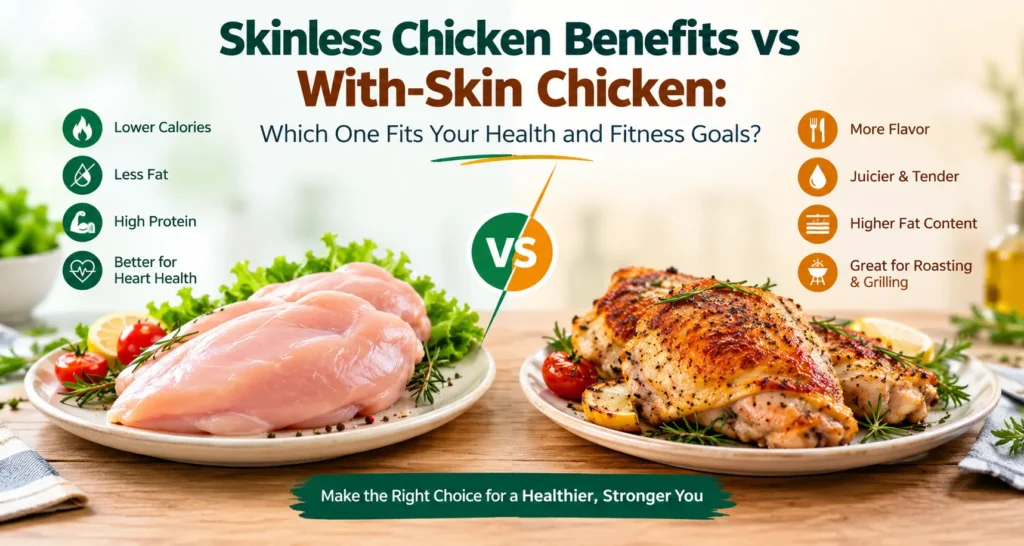
Skinless chicken benefits are usually the first thing you hear about when you start a fitness plan in Bangalore. A trainer says “always remove the skin.” An aunt says “the skin is where all the taste lives.” And you are left at the counter wondering who is right.
Quick answer: The skinless chicken benefits make skin-off chicken the better everyday choice for fat loss, heart health and tight calorie tracking. Skin-on chicken is the better choice for roasting, grilling and occasional meals where flavour and moisture matter. You do not have to pick one forever.
Calories Chicken With Skin vs Without: The Real Numbers
Let us start with the part everyone argues about. The calories chicken with skin vs without differ by a noticeable margin, and the gap is almost entirely fat.
Per 100 grams of cooked breast
Using USDA based nutrition data for roasted chicken breast, here is the comparison, including skinless chicken breast calories, for a 100 gram serving.
| Nutrient (per 100 g, cooked breast) | Skinless | With skin |
|---|---|---|
| Calories | About 165 kcal | About 195 kcal |
| Protein | About 30.8 g | About 29.6 g |
| Total fat | About 3.6 g | About 7.7 g |
| Saturated fat | About 1.0 g | About 2.2 g |
| Cholesterol | About 84 mg | About 83 mg |
| Share of calories from fat | About 21% | About 37% |
So in the calories chicken with skin vs without comparison, the skin adds roughly 30 calories and 4 grams of fat per 100 grams. Protein barely changes. That is the whole trade.
Per serving, as people actually eat it
The Ohio State University extension team compared a 3 ounce skinless roasted breast with a breast that still had its skin. The skinless piece came in at 142 calories, 3 grams of fat and 1 gram of saturated fat. The skin-on piece came in at 193 calories, 8 grams of fat and 2 grams of saturated fat. You can read their full breakdown in this Chow Line article on chicken with skin.
That is an extra 51 calories and 5 grams of fat. The calories chicken with skin vs without gap does not sound dramatic. It is also why this topic gets misunderstood, because one meal hardly matters. Repetition is what matters.
What the gap looks like over a year
Over a year, the calories chicken with skin vs without difference grows. Eat skin-on breast once a week and you add around 2,600 calories a year. Eat it every day and you add around 18,600 calories a year. As a rough rule of thumb, that is about two to two and a half kilos of body fat if nothing else changes. Real bodies are not calculators, so treat that as a ballpark and not a promise.
Protein per 100 calories
Here is a number most posts on calories chicken with skin vs without skip. Because skinless chicken breast calories stay low, you get about 18.8 grams of protein for every 100 calories. Skin-on breast gives you about 15.2 grams. If you are chasing a protein target on a calorie budget, that gap adds up faster than you think. We cover daily protein goals in detail in our guide to chicken protein per day for gym goals.
Chicken Skin Fat Content: What Is Actually in It
Chicken skin has a bad reputation, and some of it is earned. But the full picture of chicken skin fat content is more interesting than “skin is unhealthy.”
Most of the fat is unsaturated
In the USDA based entry for skin-on breast, roughly 2.2 grams of the 7.7 grams of fat per 100 grams is saturated. The rest, around 4.6 grams, is monounsaturated and polyunsaturated fat. That means about 60 percent of the fat in skin-on chicken is the unsaturated kind. Nobody should call it a health food, but it is not the villain it is made out to be.
Why saturated fat still matters
Saturated fat is the part to keep an eye on. The skin more than doubles the saturated fat in a breast portion. The American Heart Association’s eating guidance lists skinless poultry among its preferred protein choices, and that is the main reason cardiologists and dietitians usually say “remove the skin” for people with raised cholesterol or a family history of heart disease. You can browse their guidance at the American Heart Association website.
Cholesterol is not the difference
A common belief is that the skin is where the cholesterol hides. The numbers above say otherwise. Cholesterol is nearly identical with and without the skin, around 83 to 84 mg per 100 grams. The real difference in chicken skin fat content is saturated fat and total calories, not cholesterol.
Skin and the cooking medium
The chicken skin fat content also behaves differently in the pan. Skin-on chicken releases fat as it cooks. In a roast, that fat drips away. In a curry, it melts straight into the gravy, and you eat it. This is one of the main reasons a daily curry is the worst place for skin-on chicken, and we will come back to it below.
7 Skinless Chicken Benefits Worth Knowing
Now that the numbers are clear, here are the skinless chicken benefits that actually change how you eat day to day.
1. Fewer calories per serving
The calories chicken with skin vs without gap works out to about 30 calories per 100 grams, or around 50 calories on a typical portion. For someone eating chicken five or six days a week, that is a meaningful saving that costs you nothing in protein.
2. Roughly half the saturated fat
Skinless breast carries about 1 gram of saturated fat per 100 grams. With skin, it is more than double. That is one of the strongest skinless chicken benefits for anyone managing cholesterol or blood pressure.
3. More protein for every calorie, a top skinless chicken benefit
As we saw earlier, 18.8 grams per 100 calories against 15.2 grams. If you train regularly, this is the benefit that matters most. It lets you hit protein targets without eating into your carbohydrate budget.
4. Easier macro tracking
Skin is unpredictable. A thin-skinned chicken and a fatty one can differ a lot. Skinless meat is far more consistent, so your food log is more accurate. That helps if you count macros or follow a coach’s plan.
5. Lighter, cleaner curries
Skinless pieces do not leave a layer of orange oil on top of your gravy. You can still make a rich masala, but you control the fat through the oil you add, not through whatever the skin releases.
6. Better fit for weight loss phases
When you are in a deficit, the calories chicken with skin vs without gap matters, because every calorie needs to earn its place. Lean chicken keeps you full thanks to protein, without using up your daily allowance on fat you did not choose. For ideas that work in real kitchens, see our high protein chicken meal prep ideas.
7. Simple portion planning
Because skinless chicken breast calories are predictable, skinless boneless chicken is easy to weigh, divide and freeze. If you are not sure how much to buy, our guide on how much chicken per person gives a simple gram-wise answer for every meal.
Skinless Chicken Breast Calories and Other Cuts
Breast is the cut most people mean when they talk about lean chicken, so let us be precise. Skinless chicken breast calories sit at about 165 calories per 100 grams cooked, with around 31 grams of protein. Raw skinless chicken breast calories look lower because cooked chicken loses water, so always compare raw with raw and cooked with cooked when you log your food.
Raw weight vs cooked weight
This trips up a lot of beginners. A 150 gram raw breast usually shrinks to somewhere around 110 to 120 grams after cooking. If you weigh raw and log cooked skinless chicken breast calories, you will overestimate your intake. Pick one method and stay consistent.
Breast, thigh, drumstick and wings
Fat is not only about skin. The cut matters too, and it shapes which healthy poultry cuts Bangalore households should stock. Breast is the leanest. Thighs and drumsticks are dark meat and carry more fat even without skin. Wings are mostly skin, so they are the highest in fat of the common cuts.
| Cut | Fat level (skinless) | Best use |
|---|---|---|
| Breast | Lowest | Tikka, grilling, stir fry, meal prep, soups |
| Drumstick | Low to moderate | Curries, tandoori, pressure cooking |
| Thigh | Moderate | Curries, biryani, kebabs, slow cooking |
| Wings | High (mostly skin) | Occasional grills and roasts |
A skinless thigh can still be a fine fitness food. It stays juicy and forgiving, and many people stick to their plan better when dinner actually tastes good. The numbers for every cut are searchable on the USDA FoodData Central database if you want to check specific values.
Healthy Poultry Cuts Bangalore Shoppers Should Know
If you shop for healthy poultry cuts Bangalore markets and online stores offer, a few simple rules will save you time and money.
Know what you are buying
Among healthy poultry cuts Bangalore stores sell, most curry cuts come skin-off, which already suits everyday cooking. Whole birds and some leg pieces may come with the skin. Boneless pieces are usually breast or thigh. Not sure which format suits your kitchen? Our comparison of chicken curry cut vs whole chicken walks through the pros and cons of each.
Freshness matters more than the label
Even the best healthy poultry cuts Bangalore sellers stock are not healthy if they have sat too long. Look for firm, pale pink meat, no sour smell and clean packaging. Our guide to fresh chicken in Bangalore explains how to buy, store and cook it, and the article on fresh chicken vs frozen chicken covers texture and nutrition differences.
Antibiotic-free is part of the health picture
Skinless chicken benefits cover the fat side of healthy eating. Knowing how the bird was raised is the other half. If you have children at home or you simply want cleaner protein, read regular vs antibiotic free chicken before your next order.
Country chicken is a different conversation
Country birds are leaner and tougher, and the skin behaves differently too. Our comparison of country chicken vs broiler chicken covers taste, price and cooking time.
Order from a source you trust
Convenience helps you stick to a plan, and good healthy poultry cuts Bangalore delivery makes it easier. You can browse the full range in the Diamond Fresh Chicken category page and choose the cut that matches your goal. If you are new to ordering online, here is our guide to buying chicken online in Bangalore, and you can compare current chicken prices in Bangalore before you decide.
When Skin-On Chicken Makes Sense
Skinless is not always the answer. There are good reasons to keep the skin on, and a smart eater knows when.
Roasting a whole chicken or large pieces
Skin works like a natural basting jacket. It protects the meat from drying out and gives you crisp, golden edges. A roast chicken without skin is often dry, especially the breast. Skinless chicken benefits fade in a roast, because dryness ruins the meal. For a Sunday roast, skin-on is simply the better cooking choice.
Grilling and tandoori on the bone
Bone-in, skin-on legs handle high heat well. The fat renders, the skin chars slightly and the meat stays tender. You can eat the meat and leave most of the skin on the plate if you want the best of both worlds.
Bulking or high calorie phases
If you struggle to eat enough, skin-on chicken is an easy way to add calories without adding volume. Some people on a bulk find it helpful, especially hard gainers who feel full too quickly.
Low carb and keto eating
People who eat low carb often need more fat in their meals. Skin-on thighs and drumsticks fit those plans naturally, and they keep dinners satisfying.
Older adults and anyone with a small appetite
Some seniors and recovering patients need more calories in smaller portions. Skin-on chicken, cooked well and in moderation, can help. This is a conversation to have with a doctor or dietitian, not a rule to follow blindly.
Broths, soups and stocks
Skin and bones add body and flavour to broth. Simmer with the skin on, then skim the fat or discard the skin before serving. If the weather turns cool, our chicken soup recipes for cold weather are a good place to start.
Special occasions
A festive biryani, a birthday roast or a family dinner is not the moment to count every gram. One skin-on meal in a good week of eating will not undo your progress. Our Bangalore donne biryani recipe is a worthy reason to relax the rules.
Best Cooking Methods for Skinless Chicken
The biggest complaint about lean chicken is that it turns dry and rubbery. That is a cooking problem, not a chicken problem. Use these methods and you keep all the skinless chicken benefits while the meat stays juicy.
Marinate in yogurt and spices
A yogurt based marinade gently tenderises the meat and carries flavour deep inside. Thirty minutes helps, and a few hours is better. Add ginger garlic paste, red chilli, turmeric and a little lemon juice. This is the classic tikka method for a reason.
Use a quick brine
Soak the pieces in salted water for 20 to 30 minutes before cooking. The meat holds on to moisture much better. Pat it dry before it hits the pan.
Do not overcook it
This is the single biggest mistake. The safe internal temperature for chicken is 74 degrees Celsius (165 degrees Fahrenheit), as set out in the USDA safe temperature chart. Go beyond that and skinless breast gets dry fast. A cheap kitchen thermometer pays for itself in a week.
Poach or steam for meal prep
Gentle simmering in seasoned water keeps skinless breast soft, and skinless chicken breast calories stay low because no oil is added. Shred it for salads, wraps and rice bowls. This works well on a busy Sunday when you are prepping for the week.
Pressure cook for curries
Skinless pieces stay tender in a short pressure cook. Use a smaller amount of oil, a base of onion and tomato, and finish with fresh coriander. You get a proper curry without the oil slick.
Air fry, grill or pan sear
For dry heat, marinate first and use a light brush of oil. Sear on a hot pan for a couple of minutes per side, then lower the heat and finish gently. Let the meat rest for five minutes before cutting.
Quick ideas for busy weeknights
If you cook for yourself after a long shift, our list of quick 15 minute chicken recipes for bachelors shows how to build a lean dinner with very little effort.
Best Cooking Methods for Skin-On Chicken
Chicken skin fat content is not fixed, and a bit of technique changes it. Get the skin right and the whole dish improves.
Dry the skin well
Wet skin steams instead of crisping. Pat the pieces dry with kitchen paper. For a whole bird, leave it uncovered in the fridge for a few hours, or overnight if you can.
Season generously
Salt the skin and the meat. A dry rub with salt, pepper, paprika or garam masala works well. A little oil is enough, because the skin will release its own.
Roast at high heat
Start the oven hot, around 200 to 220 degrees Celsius, so the skin crisps. Cook until the thickest part reaches 74 degrees Celsius. Rest the bird for 10 to 15 minutes so the juices settle.
Use a rack so the fat drips away
Place the chicken on a rack over a tray. The fat renders and drips down, which lowers the chicken skin fat content you actually eat compared with a piece that sat in its own grease. Skip the tray drippings if you are watching calories.
Cook with the skin, eat without it
This is a trick worth remembering. Cook the chicken with the skin on to keep it moist, then peel it off before eating. You keep the juicy texture and sidestep most of the chicken skin fat content. The Ohio State article mentioned earlier recommends this exact approach.
Air fry for crisp skin with less oil
An air fryer can crisp skin-on pieces with very little added fat. Use a rack or perforated tray so the rendered fat drains away. Cook at around 190 degrees Celsius, flipping halfway.
Daily Curry or Sunday Roast?
This is where the whole debate becomes practical. Think of it by dish, not by ideology.
| Dish | Better choice | Why |
|---|---|---|
| Everyday home curry | Skinless | Skin melts into gravy and adds hidden fat and calories |
| Chicken tikka or kebab | Skinless | Yogurt marinade keeps lean meat tender |
| Meal prep boxes | Skinless | Easy to weigh, store and reheat |
| Soup and stock | Skin-on, then discard | Skin adds body to the broth |
| Whole roast chicken | Skin-on | Skin protects the breast and gives crisp texture |
| Tandoori legs on the bone | Skin-on | Holds moisture under high heat |
| Festive biryani | Either | Choose based on the occasion and your plan |
A sensible rhythm for most active adults is skinless on four to six days of the week and skin-on for a roast or grill once a week. That keeps your average intake low and your meals enjoyable. If you are dealing with leftovers, learn the signs that chicken has gone bad before you reheat anything.
Matching Your Fitness Goal
Different goals call for different choices, and the skinless chicken benefits matter more for some goals than others. Use this as a starting point, then adjust with your own coach or dietitian.
| Goal | Recommended approach |
|---|---|
| Fat loss | Skinless breast and lean cuts for most meals, since skinless chicken breast calories are the lowest of the common cuts. Roast skin-on only occasionally and peel it off. |
| Muscle gain | Mix skinless for protein and skin-on thighs or drumsticks when you need extra calories. |
| Weight maintenance | Mostly skinless, with one skin-on meal a week for variety. |
| Heart health or high cholesterol | Skinless as the default, because chicken skin fat content is higher in saturated fat. Check with your doctor about portions. |
| Low carb or keto | Skin-on thighs and drumsticks fit well because the fat helps satiety. |
| Children and toddlers | Follow your paediatrician. Soft, well cooked, skinless pieces are the usual start. |
Speaking of children, new parents often ask about skin and safe textures. Our guide to chicken for babies as a first food covers safe ways to start solids.
How much protein should you aim for?
Needs vary by body weight, age and training. The ICMR-NIN dietary guidelines for Indians are a reliable reference for general protein advice, and you can find them on the National Institute of Nutrition website. If you lift weights or train hard, a sports dietitian can fine tune the number for you.
Common Myths About Chicken Skin
Myth 1: Skinless chicken has no fat
It does. Skinless breast still has around 3.6 grams of fat per 100 grams, and dark meat has more. It is lean, not fat free.
Myth 2: Removing the skin before cooking is always best
Not always. Cooking with the skin on and peeling it off before eating keeps the meat juicier, and the fat that moves into the meat is small.
Myth 3: Skin is pure poison
No. The chicken skin fat content is calorie dense and higher in saturated fat, but a moderate amount in an otherwise balanced diet is fine for most healthy people.
Myth 4: Skinless is automatically healthy
Skinless chicken breast calories climb quickly if the chicken is deep fried in batter or drowned in a creamy gravy, and the skinless chicken benefits disappear. How you cook matters as much as whether you keep the skin.
Myth 5: All chicken is the same
Quality varies. Rearing practices, freshness and handling all affect what ends up on your plate. Read how reputable producers handle their birds, such as our explainer on halal chicken processing and the cold chain.
Food Safety and Storage
Whichever of the healthy poultry cuts Bangalore stores offer you pick, and whether skinless or skin-on, safe handling comes first. Keep raw chicken at the bottom of the fridge so juices cannot drip onto other food. Use separate boards and knives for raw meat. Wash your hands after touching it, and cook it to 74 degrees Celsius. The Food Safety and Standards Authority of India publishes consumer guidance at the FSSAI website.
Storage changes with the season. Humid monsoon days and hot summer afternoons both put chicken at risk in different ways. Our guide to storing chicken safely at home in monsoon and summer has the exact steps. If you love a rainy day curry, see these rainy season chicken recipes.
Frequently Asked Questions
Is skinless chicken really healthier than chicken with skin?
For fat, saturated fat and calories, yes. The skinless chicken benefits are clearest if you eat chicken often or follow a calorie controlled plan. For an occasional roast, the difference is small.
How many calories does chicken skin add?
The calories chicken with skin vs without differ by about 30 per 100 grams of cooked breast, or around 50 calories on a 3 ounce portion, based on USDA data.
What are skinless chicken breast calories per 100 grams?
Skinless chicken breast calories are about 165 per 100 grams cooked, with roughly 31 grams of protein and 3.6 grams of fat.
Is it okay to cook chicken with the skin and remove it later?
Yes. This keeps the meat moist and cuts most of the extra fat. Remove the skin before serving or eating.
Is chicken skin bad for cholesterol?
The chicken skin fat content is higher in saturated fat, which can raise LDL cholesterol in some people. If you have high cholesterol, skinless is the safer default. Always follow your doctor’s advice.
Can I build muscle with skin-on chicken?
Yes. Protein is nearly the same with or without skin. Skin simply adds calories, which can help if you are trying to gain weight.
Where can I find healthy poultry cuts Bangalore families trust?
Look for a supplier that is transparent about sourcing and handling. You can order fresh, antibiotic-free chicken online from Diamond Fresh Chicken, and compare options in our guide to where to buy fresh chicken in Koramangala, Indiranagar and HSR Layout. Living in the north of the city? Try our list of the best places for fresh chicken in North Bangalore.
Final Verdict: Skinless Chicken Benefits and When to Break the Rule
The skinless chicken benefits are real and measurable. The calories chicken with skin vs without numbers show you get fewer calories, less saturated fat and more protein per calorie. For daily meals, curries, tikkas and meal prep, skinless is the smarter default.
But skin earns its place on the plate too. A roast, a tandoori leg, a pot of broth or a festive dinner is better with it, and one skin-on meal a week will not wreck a good diet. Use skinless to build the base of your routine and skin-on to keep eating enjoyable. Pair that with healthy poultry cuts Bangalore suppliers deliver fresh, and your routine becomes easy to keep.
If you want to put this into practice, explore fresh, hygienically handled chicken at Diamond Fresh Chicken, pick the cut that fits your goal, and plan your week using the tips above. For more practical guides, visit the Diamond Fresh Chicken blog.
Health note: This article is for general information and is not medical advice. If you have a medical condition, are pregnant, or are planning a major diet change, talk to a doctor or registered dietitian first.