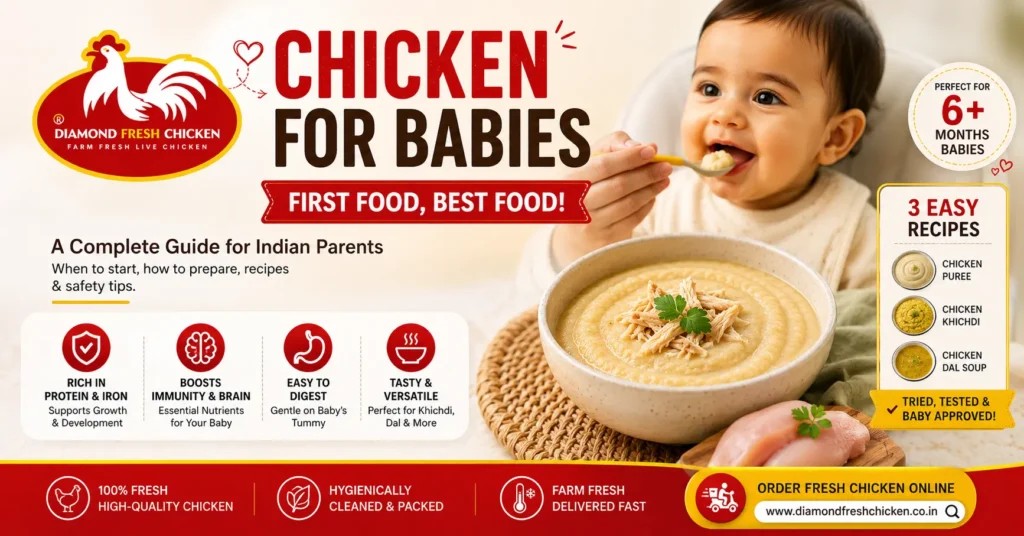
Chicken for babies first food is one of the most searched questions among new Indian parents, and for good reason. The moment your little one starts reaching for your plate, you start wondering what is actually safe to hand over. Rice cereal and mashed banana feel obvious. Chicken feels like a bigger step, and most parents want to get it right the first time.
Here is the short answer. Chicken is not just safe as an early food, it is one of the best foods you can offer once your baby is ready for solids. It is a natural source of iron and protein at exactly the age when a baby’s own iron stores from birth begin to run low. Pediatric nutrition guidance points to iron-rich foods, chicken included, as a priority once complementary feeding begins around 6 completed months. Getting this right starts with where your chicken comes from, and our guide to buying chicken online in Bangalore is a useful starting point if you are still figuring out sourcing.
This guide walks through exactly when to start, how to prepare fresh chicken safely for a baby’s first bites, which textures work at which age, three tested recipes, and the mistakes that trip up most first-time parents. Everything here is written for Indian kitchens, Indian ingredients, and Indian feeding traditions like khichdi and dal.
Why Chicken Works So Well as a First Food
Every parent asks some version of the same question: is chicken really better than starting with vegetables or fruit? The honest answer is that both matter, but chicken solves a nutritional problem that vegetables alone cannot.
By around 6 months, the iron your baby was born with starts to decline. Breast milk is wonderful for many things, but it is naturally low in iron. This is exactly the window when chicken for babies first food earns its reputation among pediatric nutritionists. A few reasons it stands out, before we get to the actual recipes further down:
- Complete protein. Chicken contains all nine essential amino acids your baby needs for muscle and tissue growth, in a form that is gentle on a developing gut.
- Highly absorbable iron. Iron from meat, known as heme iron, is absorbed far more efficiently by the body than the iron found in spinach, dal, or fortified cereal.
- Zinc and B vitamins. These support immune function and brain development during a period of rapid growth.
- Mild flavor. Unlike bitter greens or strong spices, plain cooked chicken is easy for a baby’s untrained palate to accept.
If you are already exploring vegetable purees, pairing them with chicken puree for baby once or twice a week rounds out the plate nicely without complicating your routine.
When Can Babies Eat Chicken? Age-by-Age Guide
This is where Indian advice and global advice diverge slightly, and it is worth clearing up the confusion. Global guidelines say chicken can be offered from 6 months, right alongside a baby’s very first foods. Traditional Indian practice has often waited until 7 to 9 months, introducing rice, dal, and vegetables first. WHO complementary feeding guidance supports introducing iron-rich foods like meat from around 6 completed months, alongside continued breastfeeding.
So, When Can Babies Eat Chicken Exactly?
Both approaches above are safe. What matters more than the exact month is that your baby shows real readiness. Here is a simple breakdown of when can babies eat chicken at each stage:
| Age | Readiness Signs | Chicken Texture |
|---|---|---|
| 6 months | Sits with support, head control, lost tongue-thrust reflex, shows interest in food | Smooth puree mixed with breast milk, formula, or cooking liquid |
| 7 to 9 months | Comfortable swallowing purees, starting to gum soft foods | Finely minced or shredded, mixed into khichdi, dal, or porridge |
| 9 to 12 months | Pincer grasp developing, can move food around the mouth | Small, soft, well-cooked shredded pieces as finger food |
| 12 months and up | Chewing with more control, more teeth present | Soft chunks, meatballs, or shredded chicken mixed into family meals |
If your baby is younger than 6 months, hold off entirely. No baby, regardless of how interested they seem in your plate, is ready for solid food before 6 completed months. This applies to chicken for babies first food just as much as anything else.
Chicken for 8 Month Baby: What Changes at This Stage
By 8 months, most babies have moved past thin purees and are ready for more texture. This is the stage where a lot of Indian parents specifically search for chicken for 8 month baby ideas, because it is the sweet spot between the very first tentative tastes and full finger foods.
At this age, finely shredded chicken mixed into a soft khichdi or blended lightly into dal water works beautifully. You are no longer aiming for a completely smooth puree. A slightly textured, mashable consistency helps your baby practice moving food around their mouth, which is an important motor skill milestone.
Is Chicken Safe for Babies? Allergy and Choking Facts
Safety is usually the biggest worry parents carry into this decision, and it deserves a straight answer.
Allergy Risk Is Low
Chicken is not considered one of the common allergenic foods, unlike eggs, peanuts, or shellfish. True chicken allergy in babies is uncommon. That said, the standard advice for introducing any new food still applies here: offer a small amount as a single new food, then wait two to three days before introducing another new food, watching for any rash, vomiting, or unusual reaction.
Choking Is the Real Risk to Manage
Like all meat, chicken is a genuine choking hazard if served in the wrong shape for your baby’s age. This is not a reason to avoid it, but it is a reason to prepare it correctly.
- Never serve chunks or cubes to a baby under 12 months.
- Avoid tough, stringy, or dry overcooked chicken, which is harder to break down with gums.
- Always remove skin, bones, cartilage, and any loose fatty pieces before serving.
- Stay within arm’s reach of your baby during every single meal, without exception.
Undercooked chicken carries its own risk, mainly bacteria like Salmonella and Campylobacter. Cook chicken thoroughly until it reaches an internal temperature of 74°C (165°F), with no pink meat remaining and juices running clear. For guidance on safe meat handling and storage standards in India, the Food Safety and Standards Authority of India (FSSAI) publishes detailed protocols that every household can follow. If you want a deeper primer on what actually separates safe, high-quality poultry from meat that has been sitting too long, our guide on fresh chicken versus frozen chicken is worth a read before you shop for your baby’s meals.
How to Prepare Chicken for Babies Step by Step
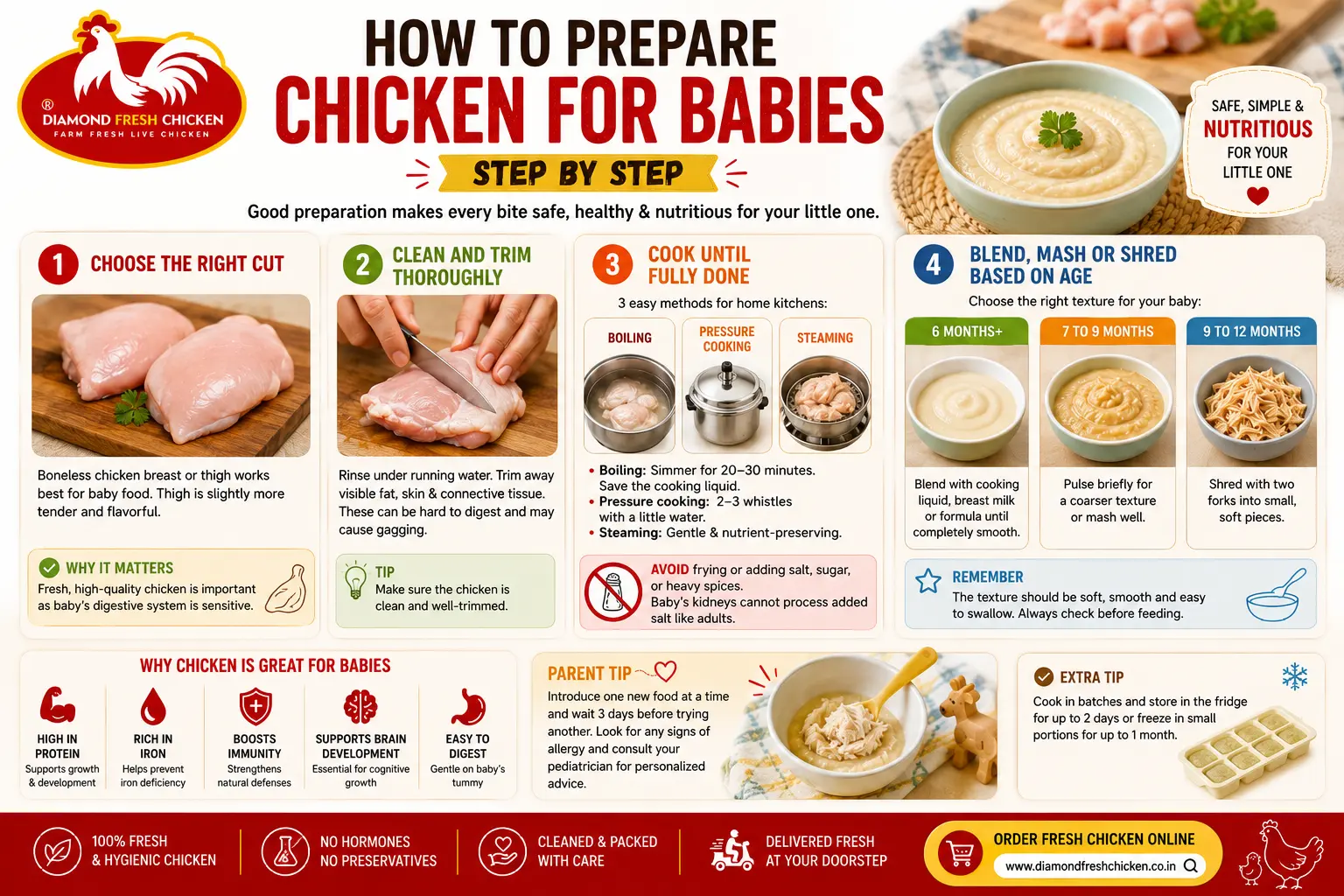
Good preparation starts before the chicken even hits your pan. Here is the process we recommend for any parent making homemade baby food chicken recipe batches at home.
Step 1: Choose the Right Cut
Boneless chicken breast or thigh works best for baby food because it is easy to shred and has minimal fat. Thigh meat is slightly more forgiving in texture and a touch more flavorful, which some babies prefer. Whichever cut you choose, freshness matters enormously at this stage since you are cooking for the most sensitive eater in your home. Sourcing consistently clean, properly chilled meat is far more important here than it is for an adult meal. Our tips on finding genuinely fresh chicken nearby apply just as much to baby’s plate as they do to your own.
Step 2: Clean and Trim Thoroughly
Rinse under running water, then trim away every visible piece of fat, skin, and connective tissue. For a baby’s first few meals, this step matters more than it does for your own cooking, since these are exactly the textures that cause gagging.
Step 3: Cook Until Fully Done
Three methods work well for home kitchens:
- Boiling: Submerge chicken pieces in water, bring to a boil, then simmer for 20 to 30 minutes until fully cooked and tender. Save the cooking liquid, it is useful for thinning purees later.
- Pressure cooking: A quick and very Indian-kitchen-friendly method. Pressure cook chicken with a little water for 2 to 3 whistles, then let the pressure release naturally.
- Steaming: Gentle and nutrient-preserving, though it takes slightly longer than boiling.
Avoid frying or adding salt, sugar, or heavy spices at this stage. A baby’s kidneys cannot process added salt the way an adult’s can, so keep early meals plain.
Step 4: Blend, Mash, or Shred Based on Age
Refer back to the age table above. For a 6-month-old, blend the cooked chicken with some of its own cooking liquid, breast milk, or formula until completely smooth. For an 8 to 9-month-old, pulse briefly for a coarser texture or shred by hand with two forks.
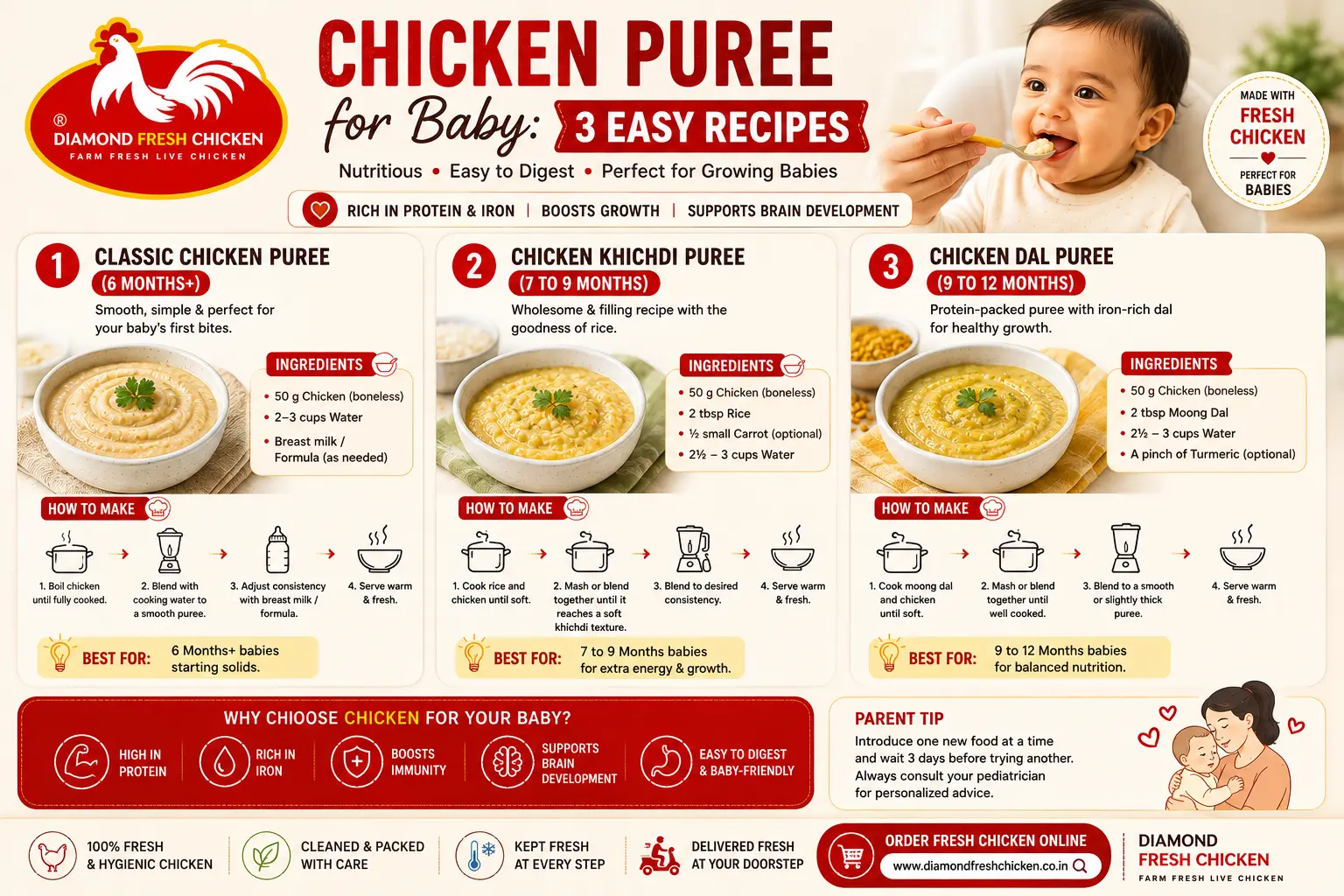
Chicken Puree for Baby: 3 Easy Recipes
These three recipes cover the full journey from first taste to finger food, and each one leans on familiar Indian ingredients your kitchen probably already has.
Recipe 1: Classic Chicken Puree for Baby (6 Months+)
Ingredients:
- 100g boneless chicken breast, cleaned and cut into small pieces
- 1/2 cup water
- A few coriander stalks (optional, for mild flavor)
Method: Pressure cook the chicken with water for 2 whistles. Let it cool slightly, then blend the cooked chicken with a little of the reserved cooking liquid until silky smooth. Adjust consistency with breast milk or formula if it feels too thick. This is the gentlest version of chicken puree for baby and a good starting point for a first-ever taste.
Recipe 2: Chicken Khichdi (7 to 9 Months)
Ingredients:
- 50g finely shredded cooked chicken
- 2 tablespoons rice
- 1 tablespoon moong dal
- 1 cup water
- A pinch of turmeric
Method: Cook rice and dal together until soft and mushy. Stir in the pre-cooked, finely shredded chicken during the last five minutes so it warms through. Mash lightly with a spoon before serving. This one-pot meal is a favorite because it combines protein, carbohydrates, and a texture that is easy to gum.
Recipe 3: Soft Chicken and Vegetable Mash (9 to 12 Months)
Ingredients:
- 50g shredded cooked chicken
- 1/4 cup boiled and mashed carrot or sweet potato
- 1 tablespoon cooking liquid or ghee
Method: Combine the shredded chicken with the mashed vegetable and a spoon of the reserved liquid or a small amount of ghee for healthy fat. Mash together, leaving some texture rather than blending smooth. This bridges the gap nicely before your baby moves fully onto finger foods.
Chicken Textures by Age: 6 to 12 Months and Beyond
Texture progression is where most parents either move too fast or stay too cautious for too long. Neither extreme is ideal. Moving too fast increases choking risk. Staying on purees for too long can actually delay a baby’s chewing development.
- 6 months: Smooth, runny puree, thin enough to drip slowly off a spoon.
- 7 months: Slightly thicker puree with very fine shreds mixed in.
- 8 to 9 months: Soft, finely minced texture, mashable between two fingers.
- 10 to 12 months: Small, soft shredded pieces the size of a grain of rice, offered as finger food.
- 12 months+: Soft chunks, small meatballs, or chicken mixed naturally into family meals like idli, dosa, or soft chapati rolls.
A simple rule that pediatric feeding specialists often repeat: if a piece of chicken can be flattened between your thumb and finger without much effort, it is likely soft enough for your baby’s current stage.
7 Common Mistakes Parents Make
Even well-prepared parents slip up here. These are the mistakes we see most often when families are new to offering chicken for babies first food.
- Serving cubed chicken too early. Cubes, no matter how small, are a top choking hazard for babies under 12 months. Shred or mince instead.
- Adding salt “for taste.” A baby’s kidneys are not ready to filter added sodium. Let the natural flavor of good quality chicken carry the dish.
- Overcooking until it turns dry and rubbery. Dry chicken is genuinely harder for a baby to manage in the mouth. Cook just until done, not longer.
- Skipping the trim step. Leftover cartilage, small bone fragments, or tough skin are easy to miss and dangerous to serve.
- Reheating chicken more than once. Repeated reheating raises bacterial risk. Portion and reheat only what your baby will eat in one sitting.
- Using low-quality or improperly stored meat. This matters more for babies than adults. Always check where your meat is coming from and how it has been handled before it reaches your kitchen, using the same freshness checks covered earlier.
- Waiting too long to add texture. Staying on purees well past 9 to 10 months can slow down a baby’s chewing skills. Progress texture gradually rather than indefinitely.
Storing and Reheating Chicken for Babies
Batch cooking saves enormous time, and chicken freezes well when handled correctly. The same batch-cooking logic behind our high-protein chicken meal prep guide for adults works just as well scaled down for baby portions.
- Refrigerator: Store cooked, cooled chicken puree or shreds in an airtight container for up to 2 days.
- Freezer: Freeze in small ice-cube trays or silicone baby food trays for up to 1 month. Once frozen solid, pop out and store in a labeled freezer bag.
- Thawing: Always thaw in the refrigerator overnight, never on the counter at room temperature.
- Reheating: Reheat only the portion you plan to serve, until steaming hot throughout, then cool to a safe eating temperature before offering it to your baby. Discard any leftovers from the bowl your baby has already eaten from.
Frequently Asked Questions
Is chicken a good first food for babies?
Yes. Chicken for babies first food is widely recommended because it delivers iron and protein at the exact stage when a baby’s iron stores begin to decline, alongside being low-allergen and mild in flavor.
When can babies eat chicken in India?
Most Indian pediatricians suggest introducing chicken anywhere from 6 to 9 months, once a baby has shown clear readiness signs for solids. There is no single “correct” month, readiness matters more than the calendar.
How much chicken puree for baby is a safe portion?
Start with just one or two teaspoons at the very first serving. Gradually increase to 2 to 3 tablespoons by 8 to 9 months, and roughly a small palm-sized portion by 12 months, always alongside a variety of other foods.
Can I give chicken soup instead of solid chicken for babies?
Clear chicken soup or broth is a gentle way to introduce the flavor early on, but it should not replace the actual meat, since the broth alone does not carry the same iron and protein content.
What is the best chicken for 8 month baby meals?
Boneless chicken breast or thigh, boiled or pressure cooked plain, then finely shredded and mixed into khichdi, dal, or a soft mash, works best at 8 months.
Can babies have chicken every day?
Two to three times a week is a reasonable, balanced frequency for most babies. Rotating with dal, fish, egg, and vegetables ensures a wider range of nutrients rather than relying on any single food daily.
Final Thoughts
Introducing chicken for babies first food does not need to feel intimidating once you understand the basic rules: wait for real readiness, cook it plainly and thoroughly, match the texture to your baby’s age, and always stay close during meals. Start small, watch how your baby responds, and build up gradually from a smooth puree to shredded pieces to soft finger food over the following months.
The single biggest factor within your control is the quality of the meat you start with. A baby’s first meals deserve the same care you would want for your own plate, if not more. If you are setting up a weekly routine around homemade baby food chicken recipe batches, sourcing consistently fresh, properly handled chicken makes every step after that easier and safer, and it is worth extending that same standard to the rest of the household.