
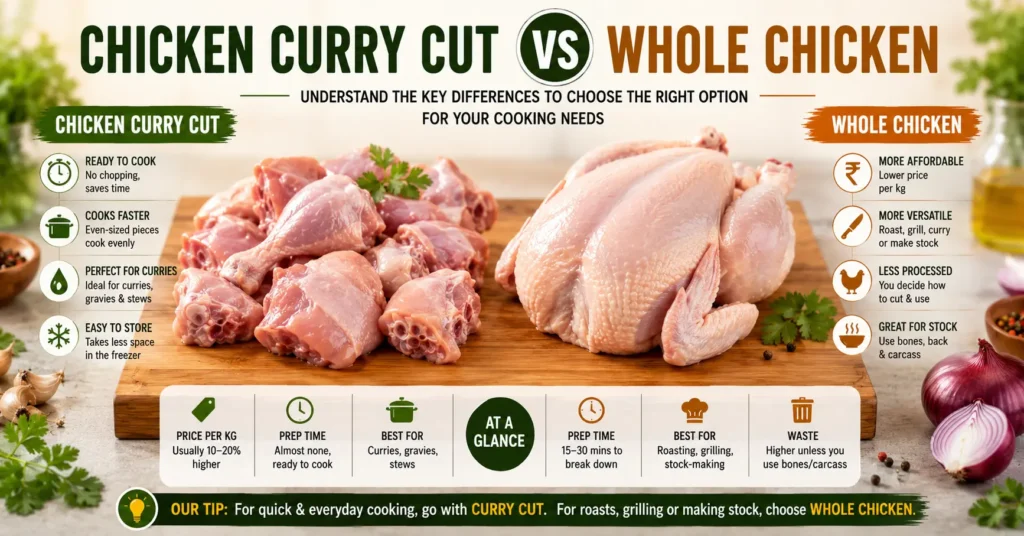
If you have ever stood in front of a chicken counter wondering whether to grab the pre-cut tray or the whole bird, you are not alone. The chicken curry cut vs whole chicken question comes up every single week for home cooks who want good food without wasting money or time. Both options come from the same chicken, but they behave very differently once they land in your kitchen, and the “right” choice depends on what you are cooking, how much time you have, and how many people you are feeding.
In this guide, we will break down the real differences between chicken curry cut vs whole chicken. We’ll go through price per kilo, prep time, waste, flavor, and storage, plus which recipes each one suits best. By the end, you will know exactly which format to pick the next time you are at the butcher shop or scrolling through an online grocery app.
What Is Chicken Curry Cut?
Curry cut chicken refers to a whole bird that’s already been broken down into small, bone-in pieces, usually somewhere between 8 and 14 pieces per bird, sized specifically for curries, gravies, and stews. Unlike a whole chicken, curry cut chicken skips the step of dealing with a full carcass. The butcher removes the skin in most markets, separates the drumsticks, thighs, wings, and breast, then chops each piece into two or three smaller chunks so they cook evenly in a pot of gravy.
This format is extremely popular in Indian, Southeast Asian, and Caribbean cooking, where recipes call for bite-sized bone-in pieces that soak up spices quickly. When people search for curry cut chicken, they’re usually looking for exactly this: a ready-to-cook format that goes straight from the packet to the pan.
How Curry Cut Chicken Is Typically Portioned
A standard curry cut pack usually includes a mix of:
- Drumstick pieces (often cut in half)
- Thigh pieces (cut in half or thirds)
- Breast pieces (cubed or chopped with bone)
- Wings (sometimes whole, sometimes split)
- Back and neck pieces (in some regional cuts, used for stock flavor)
Because every piece is roughly the same size, these pieces cook more evenly than trying to chop a whole bird yourself at home, especially if you do not have butchering experience.
What Is a Whole Chicken?
A whole chicken is exactly what it sounds like. You get the entire bird, typically sold with skin on and bone in, sometimes with giblets included. Nothing has been portioned, so you get every part: breast, thighs, drumsticks, wings, back, and often the neck.
Buying whole is the traditional way to purchase chicken, and it remains popular for a simple reason: you get more control. You decide how to cut it, whether to roast it in one piece, spatchcock it, or break it down into the exact cuts you need for a specific dish.
Common Whole Chicken Weights
Whole chickens usually range from 1 to 2.5 kg depending on the breed and region. A mid-size whole chicken (around 1.5 kg) is generally enough to feed a family of four when roasted, or it can stretch further when used in soups and stocks after the meat has been picked off the bones.
Chicken Curry Cut vs Whole Chicken: Side-by-Side Comparison
Here is a quick snapshot before we go deeper into each factor. This table is the fastest way to understand the chicken curry cut vs whole chicken trade-off at a glance.
| Factor | Chicken Curry Cut | Whole Chicken |
|---|---|---|
| Price per kg | Usually 10–20% higher | Usually lower |
| Prep time | Almost none, ready to cook | 15–30 minutes to break down |
| Best for | Curries, gravies, stews | Roasting, grilling, stock-making |
| Waste | Low, pre-trimmed | Higher unless you use bones/carcass |
| Skill needed | None | Basic knife skills helpful |
| Freezer efficiency | Excellent, flat and even pieces | Bulkier to store |
| Cooking time | Faster, more even cooking | Longer, especially whole roasting |
As you can see, neither option wins across every category. The right pick depends on your cooking style, which is exactly why this comparison matters.
Price Comparison: Cost Per Kilo Explained
One of the biggest reasons people search for chicken curry cut vs whole chicken is to figure out which one is cheaper. The honest answer is: whole chicken almost always costs less per kilogram than the pre-cut version.
This makes sense once you understand what you are paying for. When you buy pre-portioned chicken, you’re also paying for the butcher’s labor, since it takes real time to clean, portion, and package a bird into ready-to-cook pieces. That labor cost gets added to the price per kilo.
Whole chicken, on the other hand, is sold in its rawest, least-processed form. You are essentially paying only for the meat itself, not for any of the prep work.
When Curry Cut Chicken Is Actually the Better Value
That said, price per kilo is not the whole story. If you regularly waste parts of a whole chicken because you don’t know how to use the back, neck, or excess fat, buying pre-cut pieces can actually save you money in practice. Every piece in the pack is usable meat, so there’s almost no waste.
According to the USDA Food Safety and Inspection Service, proper poultry handling and portioning also plays a role in reducing spoilage-related waste at home, which indirectly affects the real cost of each format.
Prep Time and Convenience
This is where curry cut chicken clearly pulls ahead. With this format, there is no cutting board covered in bones, no knife skills required, and no cleanup of a carcass. You open the pack, rinse if needed, and start cooking. For busy weeknights, this convenience is a huge factor in why so many home cooks default to this ready-to-cook format.
A whole chicken requires more hands-on time. Breaking down a whole bird into usable pieces takes practice, a sharp knife, and roughly 15 to 30 minutes if you are not experienced. Even if you plan to roast it whole and skip cutting altogether, you still need to truss it, season it properly, and manage a longer cooking time in the oven.
Skill Level Required
If you’re new to cooking or simply don’t enjoy handling raw poultry with bones and skin, buying it pre-cut removes that barrier entirely. Whole chicken rewards a bit of practice. Once you learn to break one down, you’ll save money long-term, though there is a learning curve involved.
Flavor and Texture Differences
Does the format actually affect taste? To some extent, yes. Many experienced cooks argue that a whole chicken, especially when roasted, retains more moisture because the bird cooks as one connected piece, allowing juices to redistribute internally. This is part of why whole roast chicken is considered a comfort-food classic in so many cuisines.
Curry cut chicken, because the pieces are smaller and more exposed, tends to absorb marinades and spices faster. This is a major advantage for curry-based dishes, where you want the meat to soak up masala, herbs, and aromatics quickly and evenly. Smaller pieces also mean shorter cooking times, which can help retain tenderness in fast-cooked curries.
Bone-to-Meat Ratio
This format often includes a slightly higher bone-to-meat ratio per piece compared to boneless cuts, but that’s intentional. Bones add depth of flavor to gravies and stocks. If you’re making a curry, the bone marrow and connective tissue enhance the final taste of the sauce.
Waste and Usable Meat
When comparing chicken curry cut vs whole chicken, waste is an underrated factor. With this format, the butcher has already removed the parts most home cooks don’t use, things like excess fat, certain skin sections, and sometimes the innards. What’s left in the pack is almost entirely usable.
With a whole chicken, you get everything, including parts that many people do not know how to use, such as the back, neck, and giblets. If these get thrown away, you are technically paying for meat you never eat, which raises your effective cost per usable kilogram.
How to Reduce Waste With a Whole Chicken
The good news is that whole chicken waste is very avoidable. The carcass, neck, and back can all go into a pot to make chicken stock, which many home cooks consider one of the best reasons to buy whole in the first place. If you’re willing to make stock, a whole chicken can generate close to zero waste.
Storage and Freezing Tips
Curry cut chicken has a practical advantage in the freezer. Because the pieces are already small and relatively flat, they freeze faster and more evenly, and they thaw faster too, which matters for food safety. You can also portion these pieces into meal-sized freezer bags right away.
A whole chicken takes up more freezer space and takes considerably longer to thaw safely, often requiring a full day or more in the refrigerator. The FoodSafety.gov safe minimum temperature guidelines are worth reviewing regardless of which format you buy, since improper thawing is one of the most common poultry safety mistakes at home.
General Storage Guidelines
- Refrigerate raw chicken (either format) for no more than 1–2 days before cooking
- Freeze pre-cut pieces in flat, single-layer bags for faster thawing
- Freeze whole chicken tightly wrapped to prevent freezer burn
- Always thaw in the refrigerator, not on the counter
Nutrition: Does the Cut Format Change What You’re Eating?
A question that comes up almost as often as price is whether nutrition changes when you compare chicken curry cut vs whole chicken. The short answer is that the chicken itself is identical. A drumstick from a curry cut pack has the same protein, fat, and micronutrient profile as a drumstick carved off a whole bird. What changes is which parts you’re more likely to actually eat, and whether the skin is still attached.
Most curry cut packs are sold skinless, which trims a meaningful amount of fat and calories compared to a skin-on whole chicken. A 100-gram skinless chicken thigh has noticeably less fat than the same cut with skin on. If you are tracking calories or fat intake closely, this alone can tip the scale toward the pre-cut option, simply because the skin has already been removed for you before it ever reaches your kitchen.
On the other hand, a whole chicken gives you the choice. You can remove the skin yourself before cooking if you want a leaner meal, or keep it on for a roast where crisp skin is part of the appeal. That flexibility is one more point in favor of buying whole if portion control and ingredient choices matter to you.
Protein Content Stays Consistent
Regardless of format, chicken remains one of the most efficient lean protein sources available, and this doesn’t change based on how the butcher portions the bird. The USDA MyPlate protein foods guidance treats poultry as a single food group without distinguishing between whole and pre-cut formats, which confirms the nutritional foundation is the same either way. The format only affects convenience, waste, and how much fat comes along for the ride.
Best Recipes for Curry Cut Chicken
Curry cut chicken shines in recipes where the meat needs to cook directly in a sauce or gravy. Some of the best uses include:
- Classic chicken curry with onion-tomato masala base
- Chicken stew with coconut milk
- Chicken biryani (using bone-in pieces for extra flavor)
- Chicken cacciatore-style braises
- Slow-cooked chicken curry for meal prep
Because the pieces are uniform in size, these pieces cook predictably, which is especially helpful for beginner cooks who are still learning to judge doneness by eye.
Best Recipes for a Whole Chicken
A whole chicken is the better choice for recipes that benefit from cooking the bird as one piece, such as:
- Classic roast chicken with herb butter
- Spatchcocked grilled chicken
- Whole chicken soup or broth
- Rotisserie-style chicken
- Slow-roasted chicken with root vegetables
If you want to try your hand at breaking down a whole chicken yourself, this Serious Eats step-by-step breakdown guide is a genuinely useful resource for learning proper knife technique.
Which Should You Buy? Final Recommendation
So, when it comes down to chicken curry cut vs whole chicken, which one should actually end up in your cart? Here is a simple way to decide:
Choose Curry Cut Chicken If:
- You are short on time and want to cook quickly
- You are making a curry, stew, or gravy-based dish
- You are not confident with a knife around raw poultry
- You want minimal waste and maximum convenience
Choose a Whole Chicken If:
- You want to save money per kilogram
- You plan to roast, grill, or make stock
- You are comfortable breaking down poultry, or want to learn
- You want maximum flexibility in how you use each part
Many experienced home cooks actually keep both in rotation. They’ll buy whole chicken for weekend roasts and stock-making, while keeping pre-cut pieces on hand for quick weeknight curries. There is no single right answer in the chicken curry cut vs whole chicken debate; it genuinely comes down to matching the format to the dish you are making.
If you enjoyed this comparison, you might also like our guide on how to make restaurant-style chicken curry at home, or check out our best chicken marinade recipes for both curry cut and whole chicken preparations.
Frequently Asked Questions
Is curry cut chicken more expensive than whole chicken?
Yes, curry cut chicken is typically 10 – 20% more expensive per kilogram than whole chicken because you are paying for the butchering and portioning labor in addition to the meat itself.
Can I use curry cut chicken for roasting?
You can, but it is not ideal. Curry cut pieces are smaller and skinless in most cases, so they will not develop the crispy skin or juicy texture that comes from roasting a whole bird in one piece.
Which is healthier, curry cut chicken or whole chicken?
Nutritionally, both are the same chicken. The difference is in preparation, not nutrition. That said, this format is often sold without skin, which naturally lowers the fat content per serving compared to skin-on whole chicken.
How long does it take to break down a whole chicken?
For a beginner, breaking down a whole chicken usually takes 15 to 30 minutes. With practice, experienced cooks can do it in under 10 minutes.
Does curry cut chicken cook faster than whole chicken?
Yes. Because the pieces are smaller and more exposed to heat, these smaller pieces cook significantly faster than a whole bird, which typically needs 60 – 90 minutes to roast fully.
Have you tried both formats in your kitchen? Let us know in the comments whether you prefer the convenience of curry cut chicken or the value and versatility of a whole chicken.