
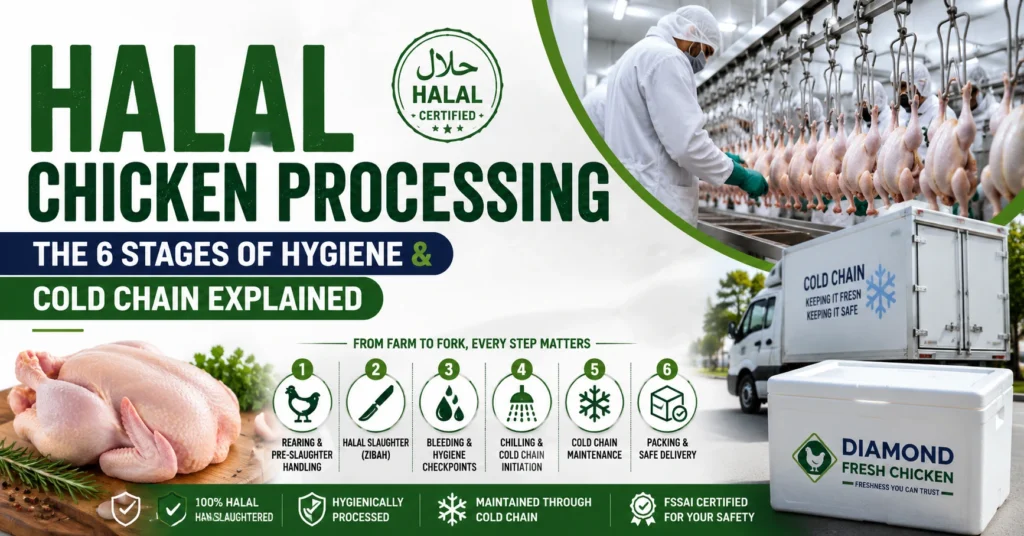
Why This Topic Deserves More Than a One-Line Answer
Ask ten people in Bangalore what “halal” means for chicken, and you will get ten different half-answers. Some think it is only about a prayer said before cutting. Others assume halal and hygienic are the same thing (they are related, but not identical). Very few people know that the temperature of the chicken thirty minutes after slaughter matters just as much as how it was slaughtered.
At Diamond Fresh Chicken, we get asked about this constantly, especially by customers comparing us to the unrefrigerated shop down the road. So we are laying out the entire process here, honestly and in detail, so you can judge for yourself what proper processing should look like before you decide where your family’s chicken comes from.
Stage 1: Rearing and Pre-Slaughter Handling
Good halal chicken processing starts long before the bird reaches the processing unit. Birds need to be healthy, adequately fed, and not stressed or dehydrated before slaughter. This is not a minor detail; a stressed or sick bird produces meat with a shorter shelf life and, in some cases, higher bacterial load.
Reputable processors carry out an ante-mortem inspection, essentially a health check on the live bird, to confirm it is fit for slaughter. Birds showing signs of illness or injury are separated out and never enter the human food chain. This is a standard requirement under India’s food safety framework, and it is the first checkpoint where a careless operator cuts corners.
What Should Happen Here
- Birds transported in clean, ventilated crates with minimal crowding
- A resting period before slaughter to reduce stress hormones in the muscle tissue
- Visual health inspection of every batch, not a random sample
- Separate holding areas kept away from the actual slaughter and dressing zones
Stage 2: Halal Chicken Processing and the Slaughter Method (Zibah)
This is the step most people are actually curious about, so let us be precise about it.
Halal slaughter, known as Zibah or Zabihah, follows a specific method rooted in Islamic dietary law. The person carrying out the slaughter recites the Tasmiya, “Bismillah, Allahu Akbar,” immediately before the cut. This is done for each bird individually, not as a blanket blessing over a batch.
The cut itself must sever the trachea (windpipe), the esophagus (food pipe), and the jugular veins in one swift motion using a sharp, clean blade. The spinal cord is not to be severed, and the head is not fully detached. The goal is rapid, complete bleeding out of the carcass, which is both a religious requirement and, practically speaking, good food hygiene, since retained blood is one of the fastest things to spoil in meat.
A few points that genuinely matter for authenticity:
- The slaughter is meant to be carried out by a person of sound mind with the explicit intention of performing a halal slaughter
- The blade must be sharp enough to complete the cut in one motion, a dull blade causing prolonged suffering is considered improper
- Only a live, healthy bird can be slaughtered for the meat to be considered halal, an already-dead or dying bird does not qualify
- In India, most Islamic scholarly bodies, including Darul Uloom Deoband, hold that hand slaughter is required and that mechanical or automated blade slaughter does not meet halal standards
For a closer look at how certifying bodies define and audit these slaughter norms, the Islamic Services of America halal certification standards page breaks down the requirements recognized internationally.
This last point is worth sitting with for a second. A lot of large-scale poultry operations run fully automated lines for speed and cost. If a brand claims halal certification while relying on machine-cut slaughter, it is worth asking which certifying body signed off on that, since the position among major Indian fatwa authorities leans firmly toward hand slaughter as the only acceptable method.
Stage 3: Bleeding, Evisceration, and Hygienic Chicken Processing Checkpoints
Once the cut is made, the carcass is hung to allow complete drainage of blood. This typically takes a few minutes and is a non-negotiable step, incomplete bleeding leaves blood pooled in the tissue, which shortens shelf life and affects both taste and halal status.
After bleeding, the bird moves to scalding (brief exposure to hot water to loosen feathers), plucking, and then evisceration, the removal of internal organs. This is one of the highest-risk points in the entire process for cross-contamination, since the digestive tract carries the bulk of any bacterial load the bird might have. Under Indian food safety guidance, poultry is required to be eviscerated and chilled to below 4°C within one hour of slaughter. That one-hour window is not arbitrary. It is the difference between meat that stays genuinely fresh and meat that starts an invisible countdown toward spoilage the moment it leaves the line.
This is also exactly why the debate around fresh chicken versus frozen chicken often misses the real point. It is not just about fresh or frozen, it is about how quickly and cleanly that first hour after slaughter is managed.
This is exactly where hygienic chicken processing either holds up or falls apart, and it is the part most casual sellers skip entirely.
India’s food safety regulator sets out detailed hygiene requirements for any facility handling meat and poultry. A compliant unit is expected to maintain physically separate zones for slaughter, dressing, chilling, and packaging, so that a carcass moving through evisceration never touches an area where finished, ready-to-pack meat is stored. Floors need to be impermeable with proper drainage, standing water is treated as a direct hygiene failure. Walls in these zones are tiled or painted with smooth, easily cleanable surfaces, and offal, the organs and non-carcass parts, is processed in a completely separate area from the main meat line.
Personal Hygiene Requirements for Staff
The people handling your chicken matter as much as the equipment. Standard requirements include:
- Clean protective clothing, aprons, gloves, and head covers worn at all times on the processing floor
- Mandatory handwashing stations at every zone transition
- No jewelry, watches, or loose items that could fall into product
- Regular health screening for staff, anyone with an open wound, illness, or infection is barred from direct product handling
- No eating, drinking, or smoking anywhere near the processing line
These are not suggestions, they are baseline expectations under India’s food safety regulations for meat handling. If you are ever unsure whether a supplier actually follows these, it is a completely fair question to ask directly, any processor confident in their setup should be able to answer it without hesitation.
Stage 4: The Cold Chain Chicken System: Chilling, Not Just Cooling
Here is where the cold chain chicken system takes over, and where a lot of “fresh” chicken quietly stops being fresh.
Immediately after evisceration, the carcass needs to hit a chilled temperature range, generally between 0°C and 4°C, and stay there. This is not a one-time dip into a cold room. It is a continuously maintained temperature band from this point all the way to your kitchen. India’s food safety framework is explicit about this: meat classified as chilled must sit within that 0 to 4°C range, and frozen meat must be held at -18°C or below, with temperature monitoring expected at every stage from slaughter through to retail.
Why does this one detail matter so much? Bacteria that cause foodborne illness, including Salmonella and E. coli, multiply fastest in what food safety professionals call the “danger zone,” roughly between 5°C and 60°C. Every minute chicken spends in that range, sitting on an open cart in Bangalore’s heat, for instance, is a minute closer to a genuine health risk. A properly managed cold chain is not a marketing term. It is the single biggest factor separating safe chicken from a stomach upset waiting to happen. You can review the official temperature and hygiene mandates directly on the FSSAI website, which sets these standards for the whole country.
What a Real Cold Chain Looks Like in Practice
- Blast chilling immediately post-evisceration to bring carcass temperature down fast, not gradually
- Insulated, temperature-controlled transport vehicles, not an open tempo or two-wheeler with a cooler box
- Continuous temperature logging, many modern facilities now use connected sensors that flag any deviation in real time
- Chilled retail display or direct-to-door delivery that never breaks that 0 to 4°C chain
This is precisely the gap that decides whether your chicken order online in Bangalore actually arrives fresh, or arrives having spent an hour warming up in a delivery bag.
Stage 5: Cutting, Packaging, and Traceability
Once chilled, the carcass is cut into the pieces you actually order, whole, curry cut, boneless, breast, or whatever your recipe calls for. This step needs the same hygiene discipline as evisceration, since cutting boards, blades, and hands are all potential contamination points if not sanitized between batches.
Good practice here includes:
- Color-coded equipment for raw versus ready-to-pack product, so nothing crosses back
- Sealed, food-grade packaging that maintains the cold chain rather than exposing the cut chicken to ambient air
- Batch labeling that allows a facility to trace any pack back to its slaughter date and processing line, this is what real traceability looks like, not just a sticker with a random date printed on it
- Weight and cut verification so you are getting exactly what you paid for
If you have ever compared boneless chicken prices across different sellers and wondered why the numbers vary so much, this is a big part of the answer. Proper hygiene, traceability, and cold chain infrastructure cost more to maintain than an open-cart operation with none of the above, and that cost shows up somewhere.
Stage 6: Final Delivery to Your Kitchen
The last leg of the journey is the one you actually witness, delivery to your door or a shop counter. This step is where all the earlier discipline can be undone in minutes if it is not handled properly.
A genuinely compliant delivery process keeps the chicken in insulated, chilled packaging from the processing facility to your hand, with no gap where it sits at room temperature. Once it reaches you, the responsibility partly shifts to your own kitchen practices, refrigerate promptly, use within the recommended window (fresh chicken is generally best used within a day or two of purchase), and always cook to a safe internal temperature.
For anyone building meals around chicken regularly, this level of care through the final mile is exactly why so many households now search for fresh chicken near me rather than settling for whatever is on the shelf at the nearest general store.
FSSAI Certified Chicken vs. Halal Certification: They Are Not the Same Thing
This is a genuinely common point of confusion, so it deserves its own section.
Halal certification confirms that the slaughter method, ingredients, and handling comply with Islamic dietary law, no contact with non-halal or impure substances, proper Zibah slaughter, and no exposure to anything haram anywhere in the supply chain. This certification is typically issued by an Islamic certifying body or Fatwa board after an audit of the slaughter process and facility.
FSSAI certification, on the other hand, is India’s mandatory food safety licensing and covers an entirely different set of criteria, hygiene infrastructure, temperature control, microbiological safety limits, permitted additives, and general food handling standards. Every meat business in India selling to the public is legally required to hold this, regardless of religious certification.
Here is the part that matters for you as a buyer: a product can be halal-certified without necessarily meeting rigorous hygiene standards, and a product can be scrupulously hygienic without following halal slaughter methods. The two systems check different things. What you actually want, and what any serious processor should be aiming for, is both, genuine halal slaughter practice combined with strict, verifiable hygiene and cold chain compliance. FSSAI certified chicken that also follows correct halal slaughter gives you both boxes ticked, not just one.
Red Flags to Watch For When Buying Chicken
After walking through the whole journey above, here is the practical checklist worth keeping in mind next time you are deciding where to buy from:
- Chicken displayed at room temperature or on an open, unrefrigerated cart
- No visible FSSAI license number displayed at the point of sale, this is a legal requirement, not an optional nicety
- Strong, sour, or ammonia-like odor, a clear sign the cold chain has already failed
- Grayish or slimy skin texture instead of a firm, slightly moist surface
- Sellers who cannot explain or answer basic questions about their slaughter method or storage temperature
- Vague halal claims with no certifying body named when you ask directly
None of these require a lab test to spot. They are things you can check with your own eyes, nose, and a couple of direct questions.
How Diamond Fresh Chicken Approaches Every One of These Steps
We built our entire process around closing the exact gaps described above. Birds are handled with proper halal slaughter practice, hygiene checkpoints are maintained at every zone transition, and the cold chain chicken discipline runs unbroken from processing through to same-day delivery. That is the standard we hold ourselves to for fresh chicken Bangalore households can actually rely on, across Koramangala, Indiranagar, HSR Layout, and other parts of the city.
We are not asking you to take our word for it blindly, that is exactly why we have laid out this entire process in detail here. Compare it against what you currently see at your usual chicken counter, and decide for yourself which one actually matches what proper halal chicken processing is supposed to look like.
If freshness and cold chain integrity matter to you as much as they matter to us, you can browse our fresh chicken cuts and pricing directly and see the difference for yourself. And if you are still weighing your options, our earlier piece on fresh versus frozen chicken and our guide to high-protein chicken meal prep are both worth a read alongside this one.
Frequently Asked Questions
Is machine-slaughtered chicken considered halal?
Among the major Indian Islamic scholarly bodies, including Darul Uloom Deoband, the widely held position is that mechanical slaughter does not meet halal requirements, and that hand slaughter with the Tasmiya recited over each individual bird is necessary. If halal status matters to you, it is worth confirming this directly with your supplier rather than assuming.
How long can fresh chicken stay outside the cold chain before it becomes unsafe?
Bacteria multiply fastest between roughly 5°C and 60°C, so even short periods at room temperature add up. As a general rule, chicken should not sit unrefrigerated for more than about an hour before use or return to cold storage, and far less on a hot day.
What is the difference between halal certification and FSSAI licensing?
Halal certification verifies the slaughter method and religious compliance. FSSAI licensing is India’s mandatory food safety framework covering hygiene, temperature control, and safe handling. A processor can legally need both, and genuinely trustworthy chicken should have both in place, not one standing in for the other.
Why does some chicken smell stronger than others?
A mild, neutral smell is normal for fresh chicken. A strong, sour, or ammonia-like odor usually points to a break somewhere in the cold chain, meaning the meat has spent too long outside the safe temperature range.
Does freezing chicken affect whether it is still halal?
No, freezing is a storage method and does not change halal status on its own. What matters for halal status is how the bird was slaughtered in the first place, not the temperature it is later stored at.
The Bottom Line
Proper halal chicken processing is a chain of small, disciplined decisions, correct hand slaughter, thorough hygiene checkpoints, an unbroken cold chain, and honest traceability, not a single certificate stuck on a packet. Once you know what each of these six stages is supposed to look like, you are in a much stronger position to judge any chicken seller you come across, including us.
We would rather you ask hard questions and choose confidently than take any brand’s word on faith. That is the whole point of laying this out in full.