Store chicken safely at home and you protect your family from something far more common than most people realise: seasonal food poisoning that has nothing to do with the chicken’s quality and everything to do with how it was handled after it reached your kitchen. Ask any Bangalore household what changes between April and July, and storage habits are rarely on the list. Yet chicken that sits safely for two days in December can turn risky in under twelve hours once the rains set in.
Why the Season Changes Everything About Chicken Storage
Most households treat chicken storage as a fixed routine: buy it, wrap it, put it in the fridge, cook it within a day or two. That routine is not wrong, but it assumes the environment around your fridge stays constant. It does not.
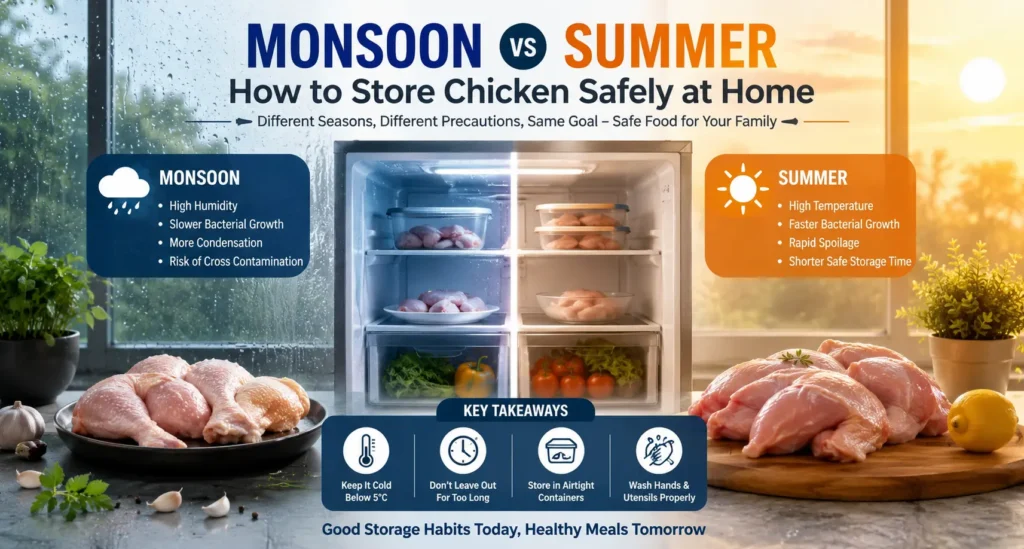
During Bangalore’s summer, kitchen temperatures can climb past 34°C, and the air is dry. During monsoon, the same kitchen might read a slightly lower 28-30°C, but humidity often sits between 80 and 90 percent. Both conditions push bacteria to multiply faster than they would in a cooler, drier month like December. The mechanism is different in each case, but the outcome is the same: your safe storage window shrinks.
If you have ever wondered how to tell if chicken has gone bad, understanding why the season matters in the first place is the missing half of that puzzle. Spotting spoilage is reactive. Storing chicken correctly for the season you are actually in is preventive, and prevention is always cheaper than a doctor’s visit.
The Danger Zone: The Science Behind Every Rule in This Guide
Every storage rule in this article traces back to one number: the temperature danger zone, which sits between 5°C and 60°C. Inside this range, bacteria such as salmonella and campylobacter do not just survive, they multiply, sometimes doubling in population every twenty minutes under ideal conditions.
This is not a rule invented by any single brand or blog. It is echoed by food safety regulators worldwide and set out directly in FSSAI’s official guidance document for poultry handling in India, which specifies chiller storage temperatures and hygiene benchmarks for exactly this reason. The same danger-zone principle appears in international food safety guidance, since bacterial growth does not change from one country’s kitchen to another.
Here is why the season complicates this. In a cool, dry month, your kitchen air rarely pushes food deep into the danger zone unless you leave it out for a long stretch. In summer, ambient heat alone can put raw chicken close to that zone the moment it leaves a proper cold chain. In monsoon, high humidity slows how efficiently your fridge compressor works, and every time the door opens, warm moist air rushes in and nudges the internal temperature upward, even if only for a few minutes at a time.
None of this means your fridge has failed you. It means the safety margin you had in cooler months has shrunk, and your storage habits need to shrink the risk right back down.
Summer Chicken Storage: What Dry Heat Does Differently
Summer’s main threat is straightforward: raw heat. When ambient temperatures cross roughly 32°C, the standard two-hour rule for how long chicken can safely sit out of refrigeration drops to just one hour. That single-hour window catches a lot of people off guard, especially if chicken sits on the counter while you finish other prep work, or if it takes a while to get from your doorstep to the fridge on a hot afternoon.
A few summer-specific realities to keep in mind when you are trying to keep raw chicken safe during the hottest months:
- Delivery gaps matter more. If your chicken sits outside your door for even fifteen minutes in peak afternoon heat, that counts toward the one-hour clock.
- Your fridge works harder just to hold its set temperature, since it is fighting a bigger gap between outside heat and the cold air inside.
- Condensation inside packaging can form faster once you move chicken between a hot kitchen and a cold fridge repeatedly, which creates a moist surface bacteria find easier to colonise.
- Marinating chicken on the counter “just for twenty minutes” adds up quickly if you are also chopping vegetables or answering the door in between.
Chicken storage tips summer households actually need are less about dramatic changes and more about tightening the timeline. Get chicken from doorstep to fridge fast, keep the fridge door closed as much as possible during the hottest part of the day, and treat the one-hour rule as a hard limit, not a rough guess.
Monsoon Chicken Storage: Why Humidity Is the Real Enemy
Monsoon plays a different trick. The ambient temperature might actually feel milder than April or May, which tricks people into relaxing their storage habits right when they should be tightening them. Humidity is the real problem, not raw heat.
When you want to know how to store chicken in monsoon correctly, start with what high humidity actually does. Moist air slows evaporative cooling inside your fridge, meaning the appliance has to run longer to hold the same internal temperature it would maintain easily in a drier month. Every door opening introduces a burst of warm, humid air, and that moisture does not disappear immediately, it lingers and raises the internal humidity of the fridge itself.
There is a second, less obvious monsoon problem: packaging. Damp air outside can cause condensation to form on the exterior of sealed chicken packs during transport, and if that moisture works its way to a seam or a poorly sealed edge, air and bacteria can get in faster than they would on a dry day. This is one reason packaging quality matters more in July than it does in January.
Monsoon also brings a practical complication that summer does not: power fluctuations. Heavy rain often means intermittent power cuts in many Indian cities, and every outage is effectively free rein for the danger zone to creep back into your fridge, even if only by a couple of degrees. If your area sees frequent monsoon outages, keep this in mind, because it directly affects how long chicken stays safely stored.
Monsoon vs Summer: Side-by-Side Storage Comparison
Seeing both seasons laid out together makes the differences easier to act on. Use this table as a quick reference whenever you are deciding how long chicken can wait before it needs to go in the fridge, freezer, or pan.
| Factor | Summer | Monsoon |
|---|---|---|
| Main risk | Direct ambient heat pushing chicken into the danger zone quickly | Humidity slowing fridge efficiency and weakening packaging seals |
| Safe time out of the fridge | Under 1 hour above 32°C | Under 2 hours, but treat as 1 hour if kitchen feels warm and sticky |
| Fridge behaviour | Works harder against outside heat, generally stable if door use is controlled | Works harder against humidity; more vulnerable to temperature creep from frequent door opening |
| Power supply risk | Occasional load-related outages | Higher risk of rain-related outages and voltage fluctuations |
| Packaging vulnerability | Lower, unless left in direct sun | Higher, due to condensation and general moisture exposure |
| Best safe-storage habit | Minimise time between delivery and fridge | Check packaging seals and consider a fridge thermometer for peace of mind |
Neither season is objectively “safer” than the other. They simply attack chicken safety from two different directions, which is exactly why a single, generic storage rule never quite covers both.
7 Rules to Store Chicken Safely at Home, Whatever the Season
These seven rules work as a year-round foundation. Some matter slightly more in one season than the other, but together they cover both.
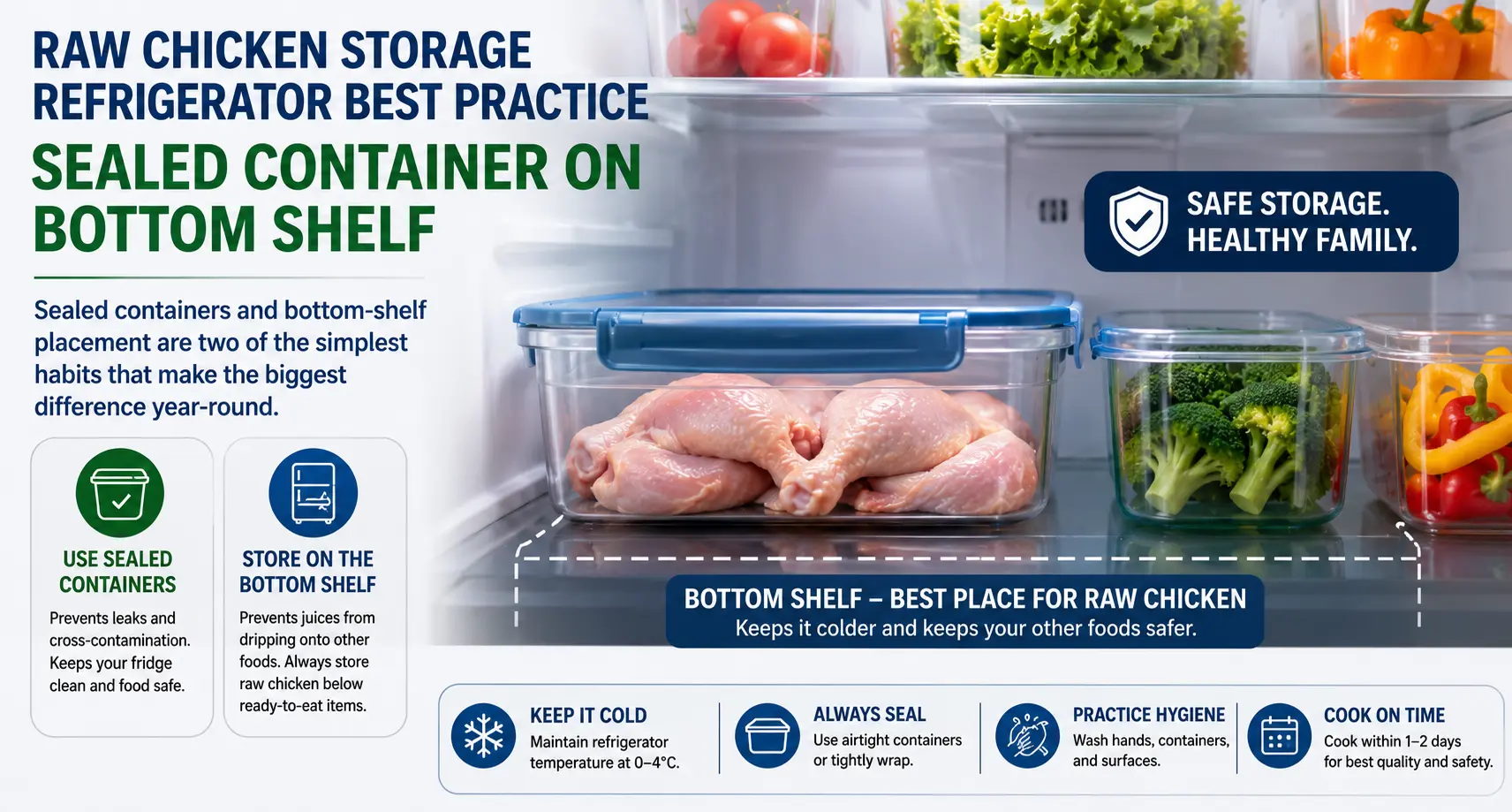
- Get chicken into the fridge within 30 minutes of it reaching your home. Do not let it sit on the counter while you unpack groceries or answer messages. This single habit protects your family more than almost anything else on this list.
- Keep your fridge at 4°C or below. A fridge thermometer costs very little and removes the guesswork, especially during monsoon when internal temperatures can drift without any visible sign.
- Store raw chicken on the bottom shelf, always. This prevents any juices from dripping onto ready-to-eat food below it, a basic but frequently skipped step in raw chicken storage refrigerator practice.
- Use a sealed, leakproof container, not just the original wrap. This matters even more in monsoon, when humidity can compromise packaging seals faster than in drier months.
- Cook or freeze within 1-2 days of purchase. If you know you will not cook it within that window, move it to the freezer immediately rather than hoping the fridge will hold it safely for longer.
- Label the date on the packaging. A marker and two seconds of effort remove the “was this bought Tuesday or Thursday” guessing game that leads to chicken sitting one day too long.
- Never refreeze chicken that has already thawed. Thawing and refreezing multiplies the risk of bacterial growth and noticeably damages texture, regardless of season.
Once these become habit, they cover the two goals every household actually cares about: how to keep chicken fresh rainy season after rainy season, and how to do it just as reliably when peak summer hits.
Raw Chicken vs Cooked Chicken: Different Rules Apply
Raw and cooked chicken do not follow identical storage timelines, and mixing up the two is a common source of confusion.
Raw chicken should be refrigerated for no more than one to two days before cooking, in any season. If your kitchen runs warm or humid, lean toward the shorter end of that window rather than the longer one.
Cooked chicken generally holds for three to four days in a properly functioning fridge. That number assumes the fridge is holding a steady 4°C or below, an assumption that becomes shakier during monsoon power fluctuations or a summer heatwave that pushes your appliance to its limit.
One rule stays constant regardless of whether the chicken is raw or cooked: if it has been sitting at room temperature for more than two hours, or more than one hour in hot or humid conditions, the safest move is to discard it rather than risk it. The USDA Food Safety and Inspection Service’s food safety basics guide lays out these same windows for perishable meat and poultry, and it is worth reading once even if you never think about it again. This lines up directly with what we covered in our guide on spotting spoiled chicken before you cook it, since storage time and visible spoilage signs work together, not as substitutes for each other.
When to Freeze Instead of Refrigerate
The freezer is your best friend in both extreme seasons, yet most households underuse it. If you have bought more chicken than you will cook within two days, freezing immediately is almost always the safer call over hoping the fridge will manage.
Frozen raw chicken stays safe for up to nine months, though quality and texture start to dip well before that mark, so aim to use it within two to three months for the best results. Frozen cooked chicken should ideally be used within two to three months as well. If you are choosing between fresh chicken and something that has already spent time in cold storage, our comparison on fresh chicken versus frozen chicken breaks down exactly how freezing changes texture, moisture, and flavour, which is worth reading before you decide how much to buy at once.
A practical monsoon tip: freeze chicken in flat, single-layer portions rather than one large block. Flat portions freeze faster, which reduces the size of ice crystals that form and helps preserve texture once thawed. This matters slightly more in monsoon, when slower freezer cycling from higher ambient humidity can mean your freezer takes a touch longer to bring food down to a stable frozen temperature.
Common Mistakes That Undo Good Storage Habits
Even careful households fall into a few repeatable traps. Watch for these:
- Washing raw chicken under the tap before storing it. This does not remove bacteria and instead risks splashing it onto your sink, counters, and nearby utensils. Store it as-is and let cooking handle the bacteria.
- Leaving chicken in a shopping bag “for a minute” while you unload everything else. That minute often becomes fifteen, and fifteen minutes matters more than people assume in peak summer heat.
- Overpacking the fridge. A fridge stuffed too full cannot circulate cold air properly, which creates warm pockets, a risk that becomes worse during monsoon when the appliance is already working harder.
- Assuming the smell test is enough. Fresh chicken that has been mishandled for a short period will not always smell different yet. Time and temperature matter just as much as your nose.
- Thawing chicken on the kitchen counter. This pushes the outer layer of the meat into the danger zone long before the centre has thawed. Always thaw in the fridge, or under cold running water if you are short on time.
Most of these mistakes are not about knowledge, they are about habit. Once you notice them, they are easy to correct.
Why Same-Day Delivery Changes the Storage Equation
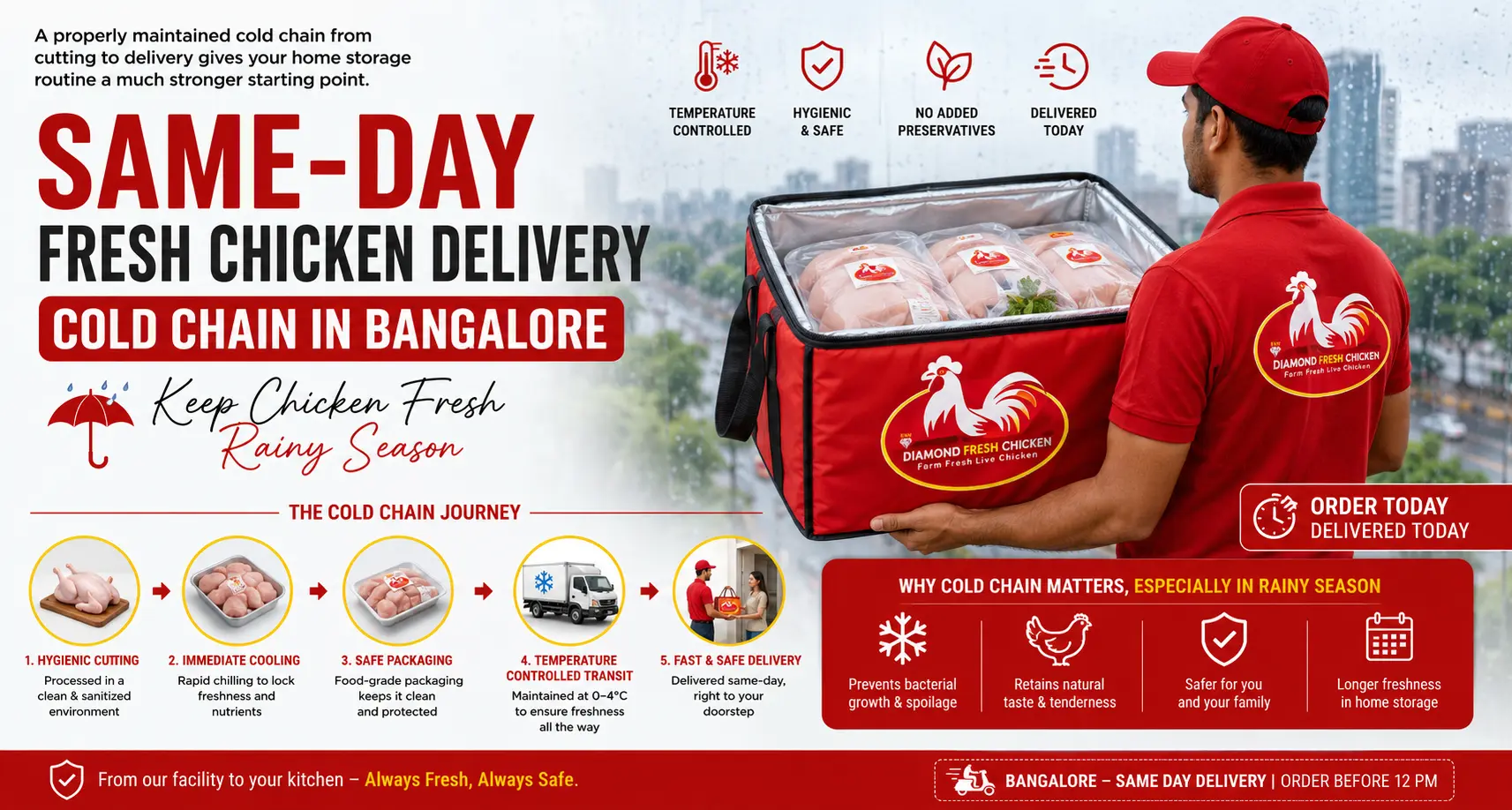
Everything in this guide assumes you are starting with chicken that was properly handled before it reached you. That assumption matters more than most people realise, because storage habits at home can only do so much if the chicken has already spent unknown hours in an uncertain cold chain before it arrives.
This is exactly why households across East Bangalore have shifted toward same-day fresh chicken delivery in Whitefield and similar neighbourhoods, rather than relying on chicken that may have sat in cold storage for days before reaching a shop shelf. When chicken is cut and delivered the same day, the storage clock in your own fridge starts from a much stronger position, and every rule in this guide works better as a result.
If you enjoy cooking with chicken through the wetter months, pairing good storage habits with the right recipes makes the season easier to enjoy rather than something to work around. Our collection of rainy season chicken recipes is built around exactly this kind of weather, warm, comforting dishes that make the most of chicken you have stored correctly.
Frequently Asked Questions
Does monsoon really make chicken spoil faster than summer?
Yes, though through a different mechanism. Summer heat pushes chicken toward the danger zone through raw temperature. Monsoon humidity slows your fridge’s efficiency and can compromise packaging, both of which shrink your safe storage window in their own way.
How long can raw chicken sit out in monsoon before it is unsafe?
Treat it the same as any warm-weather guideline: no more than two hours at room temperature, and closer to one hour if your kitchen feels warm and sticky, which is common during peak monsoon humidity.
Is it safe to store chicken in the fridge door shelf?
No. The door is the warmest part of any fridge because it is exposed to outside air every time it opens. Always store raw chicken on an interior shelf, ideally the bottom one.
Should I buy less chicken at a time during monsoon?
It is a reasonable habit if your power supply is unreliable during heavy rain. Buying smaller quantities more frequently reduces how much is at risk during any single outage or humidity spike.
Can I trust the “sell by” date alone, or do I still need to follow storage rules?
Not entirely. A sell-by date reflects packaging and shop handling, not what happens after the chicken enters your fridge. Combine the date with proper temperature control and the one-to-two-day raw chicken rule for a fuller picture.
The Simplest Way to Store Chicken Safely at Home, Every Season
Learning to store chicken safely at home is not about memorising a long list of rules for every possible weather condition. It comes down to understanding two things: what each season actually threatens, and building habits tight enough to cover both without needing to think twice. Fast fridge transfers, steady temperatures, sealed packaging, and honest timelines around raw and cooked chicken will carry you safely through July heat and August rain alike.
The other half of the equation starts before the chicken ever reaches your kitchen. At Diamond Fresh Chicken, every order is cut fresh and delivered the same day, which means your storage clock starts from the strongest possible position, no matter what the season is doing outside. If you would rather skip the guesswork altogether, browse our fresh chicken range and see how much easier storage becomes when freshness is handled properly from the very first step.