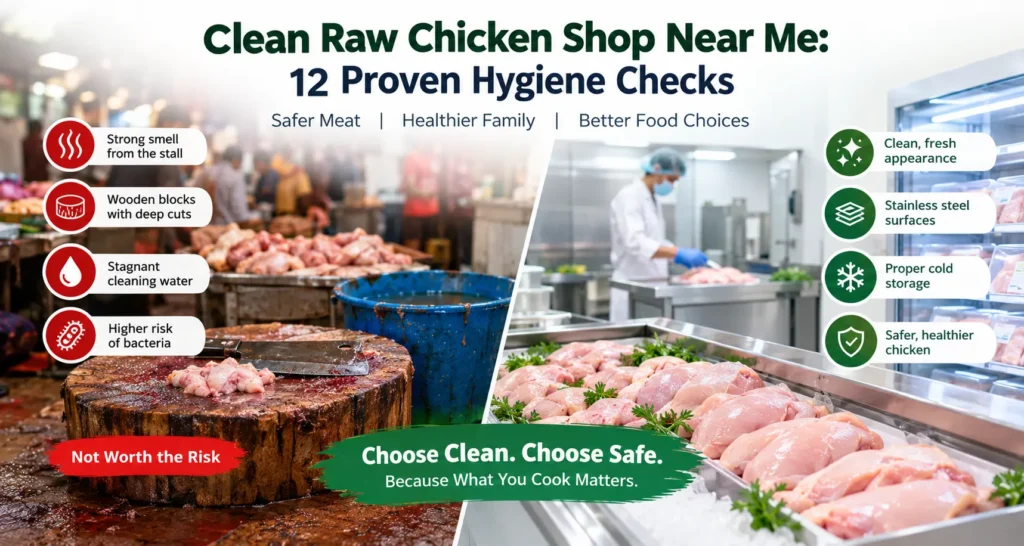
Clean raw chicken shop near me is the search most people type after something goes wrong. A curry that smelled odd even after the masala went in. A pack that leaked all over the auto seat. Or a shop where you noticed, a little too late, what the chopping block actually looked like. If that sounds familiar, you are not being fussy. You are noticing something real.
This guide explains why the smell of a wet market is more than an unpleasant detail, how wooden chopping blocks and stagnant cleaning water quietly damage meat, and what clean processing looks like when it is done properly. We wrote it for Bangalore families, and we kept the checks simple enough to run on a busy Sunday morning with a queue behind you. It comes from the team at Diamond Fresh Chicken, so we will be upfront about where our own standards sit, too.
Quick answers before you read on
- A strong smell at a chicken stall usually means bacteria have already been working on the meat for hours.
- Wooden blocks with deep cleaver marks cannot be fully sanitised. Smooth stainless steel can.
- Reused bucket water spreads bacteria from one customer’s chicken to the next.
- Air chilled chicken avoids the shared water bath and tastes cleaner and firmer.
- Use the 12 hygiene checks below at any shop, in any neighbourhood.
Why a Clean Raw Chicken Shop Near Me Is Harder to Find Than It Should Be
Bangalore is a lovely city for many things, but it is a tough place to keep raw chicken safe. Daytime temperatures sit between 24°C and 34°C for most of the year. That is warm enough for bacteria to multiply on any meat that spends too long out of a chiller.
Now picture a typical open stall. Chicken hangs or sits on a counter from early morning. Customers crowd in. A cleaver comes down on a wooden block that has seen thousands of cuts. A bucket of water sits nearby, and everything gets rinsed in it. None of this is meant to be careless. It is simply how the old system works, and it was built for a time when chicken was cooked within an hour of slaughter.
The trouble is that a busy shop is not the same as a clean shop. A long queue tells you the chicken sells fast. It tells you nothing about the block, the water, or the temperature. That is why finding a truly clean raw chicken shop near me takes a little more than checking reviews, and the same is true if you are hunting for a hygienic butcher shop Mathikere offers close to home. You need to know what to look at, and we will cover that in detail. If you want a wider overview first, our guide to finding genuinely fresh chicken near you lists seven signals worth knowing.
What Actually Makes a Wet Market Smell
Part of the smell is simple. Blood, wash water and warm air mix together, and that never smells pleasant. But a second layer of smell comes from something more important: bacterial spoilage.
Spoilage bacteria feed on the proteins and fats in raw chicken. As they grow, they release compounds that smell sour, sulphurous or faintly like ammonia. Your nose is picking up the waste products of millions of bacteria. By the time the smell is obvious, the chicken has usually spent hours in conditions that let those bacteria thrive.
Here is the part that surprises people. Smell is a late alarm, not an early one. Chicken can carry harmful bacteria such as salmonella or campylobacter and still smell almost normal. Those organisms do not always produce a bad odour. So a smelly stall is a clear warning, and a stall that smells fine is not automatically safe.
This is the first big difference when you compare fresh chicken vs market chicken. Properly chilled, quickly handled chicken has a faint, clean, almost neutral smell. Chicken that has sat warm on an open counter develops a sharper, heavier odour that no amount of marinade fully hides. Air chilled chicken and other quick chill methods avoid that harshness because the meat cools fast. That is a lot to judge by nose alone when you are standing at a counter trying to pick a clean raw chicken shop near me.
The Wooden Chopping Block Problem
Why a Shop Block Is Not a Kitchen Board
You will often hear that wooden boards are fine, and in a home kitchen the research is genuinely mixed. Some studies suggest wood is no worse than plastic when it is kept clean and dry. We want to be fair about that.
A butcher’s block is a completely different object. It is usually a thick slice of tree trunk, cut into by heavy cleavers all day, every day. It is wet from morning to night. It is rarely replaced, and it is almost never dried out completely between customers. The surface does not stay smooth for long.
What Deep Grooves Do to Raw Chicken
Every cleaver strike leaves a groove. Those grooves trap blood, fat and tiny fragments of meat. Bacteria settle into them, and a quick wipe or a splash of water does not reach the bottom. Wood is also porous, so moisture and organic matter soak into the fibres where sanitiser cannot follow.
Then comes the next customer’s order. The cleaver pulls old residue up and carries it onto fresh meat. If the same block handles chicken, mutton and fish during the day, the cross-contamination risk grows even more. This is how a perfectly healthy bird can pick up bacteria in the last minute before it goes into your bag.
What a Better Surface Looks Like
FSSAI’s hygiene requirements for food businesses expect food contact surfaces to be smooth, non-absorbent and easy to clean. You can read the wider framework on the official FSSAI website. A deeply scarred wooden block struggles to meet that description. Stainless steel chicken processing surfaces and food grade polymer boards that are replaced on schedule meet it far more easily. We will look at why in a later section.
Stagnant Cleaning Water: The Hidden Contaminant
The Bucket That Never Gets Changed
Look at the bucket the next time you stand at a busy stall. Is the water pink? Is there a layer of fat floating on top? That water has been used to rinse hands, knives, trays and the chicken itself, sometimes for the whole morning.
Once bacteria enter standing water, they spread to everything it touches. A knife dipped in that bucket is not cleaned. It is coated again. A chicken rinsed in it is not washed. It is inoculated with whatever the previous customer’s order left behind. And because the water is often at room temperature, bacteria have the perfect conditions to multiply. That one detail separates fresh chicken vs market chicken more than price ever does.
Puddles, Drains and Splash
Water on the floor causes a quieter problem. When a cleaver hits the block, droplets splash onto trays, aprons and nearby meat. A blocked or slow drain keeps old wash water sitting around for hours. Over time, bacteria form a thin, slimy layer called a biofilm on surfaces that stay wet. Biofilms resist normal cleaning, and they keep shedding bacteria back into the work area.
Clean processing treats water as an ingredient in the hygiene system, not an afterthought. Fresh potable water, drains that actually drain, and surfaces that dry between batches all matter. A clean raw chicken shop near me should be able to show you running water, not a bucket.
Time and Temperature: The Part You Cannot See
Everything above gets worse with heat. Food safety agencies describe a danger zone between 5°C and 60°C. Inside that range, bacteria such as salmonella, campylobacter and E. coli grow fast, and under warm, humid conditions their numbers can double in roughly twenty minutes. The USDA Food Safety and Inspection Service explains the same principle for kitchens and shops around the world.
Chicken on an open counter in Bangalore sits inside that zone for most of the day. A bird slaughtered at 6 am and sold at noon has spent six hours in warm air, even if it still looks pink and healthy. A properly run cold chain holds chicken between 0°C and 4°C from processing to your door. We explained how that works step by step in our guide to hygienic chicken in Bangalore and the 0°C to 4°C cold chain.
The simple takeaway: the block and the bucket spread bacteria, and the warm counter lets those bacteria grow. This is the core of the fresh chicken vs market chicken debate. You need to fix both problems, not just one. So when you search for a clean raw chicken shop near me, you are really searching for a place that has fixed both.
Fresh Chicken vs Market Chicken: Side by Side
Let us be fair here. Not every market shop is unhygienic, and some owners work very hard. But as a general pattern, the gap between fresh chicken vs market chicken comes down to how the meat is handled after slaughter. Here is how the two typically compare.
| Factor | Chilled, properly processed chicken | Typical open market chicken |
|---|---|---|
| Storage temperature | 0°C to 4°C throughout | Room temperature, often 24°C to 34°C |
| Cutting surface | Smooth stainless steel or replaceable food grade boards | Often a porous wooden block with deep grooves |
| Cleaning water | Running potable water, sanitised between batches | Reused bucket water |
| Packaging | Sealed, leak proof packs | Open tray, plastic cover or newspaper |
| Smell on opening | Faint and clean | Often sharp, sour or heavy |
| Traceability | Processing date and batch known | Usually unknown |
| Quality at home | Stays fresh for the recommended window | Spoils quickly, drips and goes slimy |
If you are also wondering where frozen chicken fits in, our comparison of fresh chicken versus frozen chicken covers taste, texture and nutrition. For this article, the point is simpler. Fresh chicken vs market chicken is not about whether the bird was killed today. It is about what happened in the hours after.
How Stainless Steel Chicken Processing Changes Things
Why Steel Beats Wood and Other Porous Surfaces
Stainless steel is not a luxury choice. It is practical. The surface is smooth and non-porous, so liquid and bacteria stay on top rather than soaking in. It does not splinter, it does not absorb blood, and it tolerates hot water and sanitiser every single day without breaking down. It also pairs well with air chilled chicken, since both aim to keep meat cold and clean from start to finish.
That matters because cleaning only works on a surface that can actually be cleaned. With stainless steel chicken processing, a worker can wash, scrub and sanitise a table in a few minutes and know the surface is truly clear. With a grooved wooden block, no amount of effort gives you that certainty.
Cleaning Cycles That Actually Work
Good stainless steel chicken processing is not just the metal. It is the routine around it. A solid cycle looks like this:
- Remove visible residue from the surface.
- Wash with detergent and clean running water.
- Apply a food safe sanitiser and give it contact time.
- Rinse where required and let the surface air dry.
- Repeat between batches, not just at closing time.
Separate equipment for raw and ready to eat products, clean crates, and staff who wash hands between tasks complete the picture. Our explainer on the six stages of halal chicken processing, hygiene and cold chain walks through how these stages connect from start to finish.
Air Chilled Chicken: Why Cold Air Beats a Shared Water Bath
Air Chilling vs Water Chilling
After slaughter, chicken has to be cooled quickly. There are two common ways to do it. In water chilling, carcasses move through a tank of cold water, often with a sanitiser added. In air chilling, carcasses pass through a chamber of cold, circulating air.
Water chilling is fast and cheap, which is why it is common worldwide. The downside is that many birds share the same water. If one carcass carries bacteria, the tank can spread them, and the meat can also absorb some of the water. That extra water shows up later as liquid in the pack and a slightly diluted flavour.
Air chilled chicken avoids both issues. Each carcass cools on its own in moving air, so there is no shared bath to cross-contaminate and no water soaking into the meat.
What Air Chilled Chicken Does for Taste and Texture
Cooks tend to notice three things with air chilled chicken. The flavour is more concentrated because the meat is not carrying extra water. The texture is firmer and less spongy. And the skin dries slightly during chilling, which helps it brown properly in a pan or an oven.
You also see less liquid in the packet and less shrinkage on the stove. When you cook a curry, the gravy stays closer to what you intended instead of turning thin and watery. This is the quiet reason many home cooks say that clean chicken simply “tastes like chicken” again.
The Honest Trade Offs
We should be straightforward here. Air chilled chicken takes longer to cool and needs more space and energy, so it usually costs a little more. Carcasses can also lose a small amount of weight as they chill. Neither point is a reason to avoid it, but it explains why not every seller offers it.
Whatever chilling method a supplier uses, the end result must be the same: meat that reaches 0°C to 4°C quickly and stays there. Ask the seller how they chill. A confident answer is a good sign. A blank look is useful information too. Any clean raw chicken shop near me that explains its chilling method openly deserves extra credit.
12 Hygiene Checks for a Hygienic Butcher Shop Mathikere Residents Can Trust
If you live in Mathikere, MSR Nagar, Yeshwanthpur, RT Nagar or nearby, you probably have a shop you have used for years. Habit is comfortable. But a hygienic butcher shop Mathikere families trust should be able to pass a simple inspection that anyone can carry out with their eyes. Use these twelve checks at any shop in any neighbourhood.
The Surfaces and the Water
- Cutting surface: Look for smooth steel, the way stainless steel chicken processing is set up, or a clean, intact board. Avoid a scarred wooden stump.
- Water source: You should see running water, not a shared bucket.
- Drainage: The floor should be wet only in a managed way, with no standing puddles.
- Separate tools: Knives and boards for raw chicken should not double as general tools.
The Chicken Itself
- Temperature: Chicken should sit in a working chiller or on ice, not at room temperature for hours.
- Colour: Pale pink and even. Grey, yellow or patchy meat is a red flag.
- Texture: Firm to the touch. Sticky or slimy skin means spoilage has started.
- Smell: Faint and clean. Sour, sharp or sulphurous is a clear no.
The People and the Paperwork
- Staff hygiene: Clean aprons, covered hair, gloves or washed hands between tasks.
- Licence: A valid FSSAI licence should be displayed. Ask to see it if it is not.
- Packaging: Chicken should go into clean, leak proof packs, not old newspaper.
- Transparency: The seller should happily explain where the chicken comes from and when it was processed.
A hygienic butcher shop Mathikere residents recommend to each other will pass most of these without effort. If a shop fails four or more, take that seriously. You can also read our wider guide on fresh chicken in North Bangalore for more tips tailored to the northern side of the city.
Questions Worth Asking the Owner
Most owners are glad to be asked. Try these three: “When was this bird processed?”, “How do you clean the block between customers?” and “How is the chicken kept cold?” You are not being rude. A good shopkeeper takes pride in these answers, and you can even ask whether air chilled chicken is on offer. If the reply is defensive or vague, you have learned something useful before spending a rupee. Any hygienic butcher shop Mathikere shoppers recommend will welcome these questions.
A Two Minute Check You Can Do at Home
Even after you find a clean raw chicken shop near me, it pays to run a quick check once the pack is in your kitchen. It takes two minutes and needs nothing but your eyes, nose and hands.
- Look: The meat should be an even pale pink with no grey patches.
- Touch: It should feel firm and slightly moist, not sticky or slippery.
- Smell: You should get almost no smell at all. A sour or sharp note means do not cook it.
- Check the pack: Excess pink liquid pooling at the bottom can point to poor handling or water absorption.
If anything feels off, trust that feeling. Our guide on how to tell if chicken has gone bad goes through seven signs you should never ignore. When in doubt, throw it out. A wasted kilo costs far less than a bad night.
Handling Raw Chicken Safely After You Buy It
Clean processing only protects you up to your front door, and your kitchen routine matters as much as the clean raw chicken shop near me that you picked. After that, the habits in your kitchen take over. A few matter most.
- Get chicken into the fridge within 30 minutes, sooner in summer.
- Keep the fridge at 4°C or below and store raw chicken on the bottom shelf in a covered container.
- Use separate boards and knives for raw chicken and anything that will not be cooked.
- Wash your hands, the sink and the counter after handling raw meat.
- Cook until the thickest part reaches a safe internal temperature and the juices run clear.
The World Health Organization’s food safety guidance stresses the same basics: keep clean, separate raw from cooked, cook thoroughly and keep food at safe temperatures. For Bangalore specifics, including how humidity changes your fridge in monsoon, read our guide on how to store chicken safely at home.
Four Myths About Market Chicken
These myths come up in almost every conversation about choosing a clean raw chicken shop near me, so it is worth clearing them up before you shop.
Myth 1: Washing the Chicken Makes It Safe
It feels logical, but food safety agencies including the USDA advise against washing raw chicken. Water splashes bacteria onto the sink, taps and nearby food. Cooking to the right temperature is what kills the bacteria, not rinsing. And if the rinse water is dirty, as it often is in a bucket, you are making things worse.
Myth 2: Strong Masala Hides Everything
Masala hides the smell. It does not remove bacteria or the toxins some of them leave behind. Cooking kills many bacteria, but it cannot always undo the damage from chicken that spent hours in the danger zone. If the chicken smelled bad before cooking, a heavy marinade is not a fix.
Myth 3: Fresh Means Killed in Front of You
Watching a bird being cut feels reassuring, and it is easy to see why. But a bird cut at 7 am and sitting warm until noon is not fresher than one chilled within the first hour and kept cold. Fresh chicken vs market chicken is decided by time and temperature, not theatre.
Myth 4: Antibiotic Free Means Hygienic
These are two separate questions. Antibiotic free describes how the bird was raised. Hygiene describes how it was processed, chilled and handled afterwards. You want both. If you are curious about the first part, our comparison of regular vs antibiotic free chicken explains what parents in Bangalore should know.
How Diamond Fresh Chicken Handles Raw Chicken
We started Diamond Fresh Chicken because the questions in this article kept coming up from our own customers. People wanted a clean raw chicken shop near me that did not depend on luck. So we built our process around the things that actually matter.
- Fast chilling: Chicken is brought to 0°C to 4°C quickly after processing, and kept there through dispatch and delivery.
- Sanitised surfaces: Processing surfaces are sanitised between batches to prevent cross-contamination.
- Sealed packaging: Chicken is packed in leak proof, sealed packs straight after chilling.
- No chemical preservatives: Cold chain discipline does the work, not additives.
- Temperature logs: Temperatures are recorded at each handoff so that gaps can be traced and corrected.
- Same day approach: Short gaps between processing and delivery keep the chicken as close to fresh as possible.
We are not claiming to be perfect. Power cuts, traffic and equipment problems happen to everyone. What matters is how a business responds, with backup cooling, honest logging and the willingness to discard stock rather than send it out. That is the standard we hold ourselves to. Whether you shop at a hygienic butcher shop Mathikere locals trust or order online, the standard should not change.
If you would rather skip the shop hunt, you can buy chicken online in Bangalore and compare price and quality before you order, or read our complete fresh chicken Bangalore guide for buying, storage and cooking advice in one place. Delivery areas depend on your address, so check availability for your location when you order.
Frequently Asked Questions
How do I find a clean raw chicken shop near me?
Look for a smooth, easy to clean cutting surface, running water, chilled storage and sealed packaging. Then run through the 12 checks above. If the shop passes most of them and the chicken smells faint and clean, you have likely found a good one.
Is a wooden chopping block really unsafe?
In a home kitchen, a clean and dry wooden board can be acceptable. A shop block that is hacked with cleavers all day, stays wet and is never replaced is a different matter. Deep grooves trap bacteria that normal cleaning cannot reach, which is why stainless steel chicken processing and replaceable food grade surfaces are safer.
What is the difference between fresh chicken vs market chicken?
Fresh chicken vs market chicken is mostly a question of handling. Fresh chicken is chilled quickly, kept cold, cut on clean surfaces and sealed. Market chicken is often held at room temperature, cut on shared blocks and rinsed in reused water. The bird may be the same. The handling is not.
Why is air chilled chicken considered better?
Air chilled chicken cools in circulating cold air instead of a shared water tank. That avoids cross-contamination through the water and stops the meat from absorbing extra moisture. Many cooks find the flavour stronger and the texture firmer. The trade off is a slightly higher price.
How can I tell if a hygienic butcher shop Mathikere offers is genuinely clean?
Check the block, the water, the temperature and the paperwork. A hygienic butcher shop Mathikere residents can rely on will display a valid FSSAI licence, use clean surfaces, keep chicken chilled and answer your questions openly.
Does stainless steel chicken processing make chicken safer?
It helps a lot. Stainless steel chicken processing gives you a smooth, non-porous surface that can be washed and sanitised properly between batches. Combined with fast chilling and clean water, it reduces the chance of cross-contamination significantly.
Final Thoughts
A clean raw chicken shop near me is not a fancy idea. It is a shop with a smooth surface, clean running water, cold storage and honest answers. Smelly wet markets are not bad because they are old fashioned. They are risky because wooden blocks, stagnant water and warm air work together to spoil meat long before it reaches your kitchen.
Use the checks in this guide, trust your nose, and do not feel awkward asking questions. Whether you choose a shop you trust or home delivery, the standard should be the same: cold, clean, sealed and traceable. Stainless steel chicken processing, air chilled chicken and an unbroken cold chain are the three things worth looking for.
Ready to taste the difference? Browse our fresh chicken range and place your first order with Diamond Fresh Chicken.