Why Temperature, Not Appearance, Decides Chicken Safety
Ask ten people how they judge whether chicken is fresh, and most will describe colour, smell, or texture. These signs matter, but they are late indicators. By the time chicken smells “off,” bacteria have often already multiplied well past a safe level. The earlier, more reliable signal is temperature history, something you cannot see just by looking at a tray in a shop.
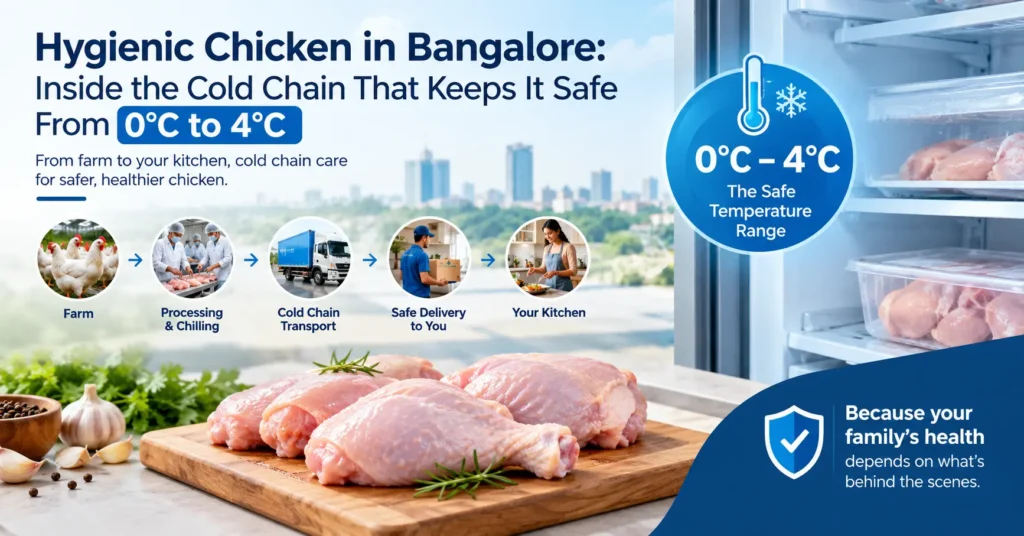
This is the entire reason hygienic chicken in Bangalore depends on cold chain discipline rather than appearance. A bird that has been kept correctly chilled from slaughter to delivery carries far less bacterial risk than one that looks identical but spent even a short window sitting warm. Once you understand this, judging hygienic chicken in Bangalore becomes less about guesswork and more about asking the right question: how was this kept cold, and for how long was it not?
Bangalore’s climate makes this harder than it sounds. Ambient temperatures regularly sit between 24°C and 34°C through most of the year, comfortably inside the range where bacteria thrive. Every extra minute chicken spends outside a chiller in this city is a minute working against food safety, not for it.
The 5°C-60°C Danger Zone Explained
Food safety regulators around the world describe a specific temperature band known as the danger zone. It runs from 5°C to 60°C. Inside this range, bacteria such as salmonella, campylobacter, and E. coli do not just survive, they multiply rapidly, sometimes doubling their population in as little as twenty minutes under warm, humid conditions.
This principle is not brand-specific guidance. It appears directly in FSSAI’s official food safety standards for meat and poultry handling in India, and the same danger-zone science is echoed internationally by agencies such as the USDA Food Safety and Inspection Service. Bacterial growth does not change from one country’s kitchen to another, which is why this range shows up consistently across every credible food safety authority.
Understanding the danger zone changes how you think about every step of chicken handling. It is not about a single moment of contamination. It is about cumulative time spent inside a temperature window where bacteria are actively working in the chicken’s favour, not yours.
Temperature Danger Zone Bacteria: What Actually Multiplies
It helps to know exactly which organisms are behind the risk, since “bacteria” as a general word can feel abstract. The main temperature danger zone bacteria found in poultry are salmonella, campylobacter, and certain strains of E. coli. Each behaves slightly differently, but all three share one trait: they grow fastest in warm, moist conditions, exactly the environment created when chicken sits between 5°C and 60°C.
Campylobacter is the most common cause of bacterial food poisoning linked to poultry worldwide, and it grows well even at temperatures many people would consider only mildly warm, not hot. Salmonella behaves similarly, thriving anywhere from around 7°C up through the mid-40s. Neither organism needs extreme heat to become dangerous. They simply need time and a temperature that is not actively working against them.
This is precisely why chilling speed matters so much more than most people assume. Slowing temperature danger zone bacteria down early, within that first critical hour after processing, has an outsized effect on total bacterial load by the time chicken reaches a plate. A slow chill early in the process cannot be fully corrected later, no matter how careful storage is afterward.
A Visual Breakdown of the Danger Zone

The chart above lays out the three zones that matter for every step of poultry handling:
| Temperature Range | Zone | What Happens to Bacteria |
|---|---|---|
| 0°C to 4°C | Safe Cold Chain Zone | Bacterial growth is slowed to a near standstill. This is the working range for hygienic chicken in Bangalore at every stage. |
| 5°C to 60°C | Danger Zone | Bacteria multiply rapidly, potentially doubling every 20 minutes in warm, humid conditions. |
| Above 60°C | Safe Cooking Zone | Most harmful bacteria are killed once internal cooking temperature is sustained above this point. |
Notice how narrow the safe zones are compared to the danger zone in the middle. That gap of 55 degrees is where nearly every food safety failure happens, and it is also exactly the range a well-run cold chain is built to avoid at every single step.
Cold Chain Poultry Delivery: How It Starts at the Farm
Good cold chain poultry delivery does not begin when an order is placed online. It begins hours earlier, at the farm, with decisions about timing that most customers never think about.
Birds are sourced fresh rather than pulled from long-term storage. This matters because every hour a bird spends between farm and processing is an hour that has to be accounted for in the temperature record. Farms supplying hygienic chicken in Bangalore operations work on tight same-day or next-day schedules specifically to minimise this window.
Transport from farm to processing facility uses insulated, chilled vehicles rather than open trucks. Even a short 30-45 minute drive without proper chilling can be enough to push chicken into the lower edge of the danger zone, especially during Bangalore’s warmer months between March and June.
Processing and Chilling: The Critical First Hour
The first hour after slaughter is the most critical point in the entire cold chain. This is when chicken is at its most vulnerable to bacterial contamination, and it is also the point where good facilities separate themselves from careless ones.
Immediately after processing, chicken is moved into rapid chilling. The goal is to bring the meat’s internal temperature down to the 0°C-4°C range as quickly as possible, ideally within 60-90 minutes. This rapid chilling step is one of the most important fresh meat safety standards in the entire supply chain, because every minute chicken spends above 5°C during this window directly adds to bacterial load.
A few things happen during this stage that most customers never see:
- Water and ambient air used in chilling are kept at controlled cold temperatures throughout.
- Processing surfaces are sanitised between batches to prevent cross-contamination.
- Chicken is packed in leak-proof, sealed packaging immediately after chilling, not hours later.
- Internal temperature checks are logged at multiple points, not just once at the end.
This is also the stage where the case for skipping chemical preservatives becomes obvious. When chicken is chilled correctly and quickly, bacteria simply do not get the window they need to multiply to unsafe levels. Preservatives exist largely to compensate for gaps in cold chain discipline. Close those gaps, and the need for chemical intervention mostly disappears.
Cold Chain Poultry Delivery to Your Door
Once chicken is chilled and packed, the next challenge is keeping it inside the 0°C-4°C range all the way to your kitchen. This is where a lot of otherwise good processing gets undone by weak logistics.
Reliable cold chain poultry delivery depends on a few non-negotiables:
- Insulated delivery vehicles or cold boxes. Standard delivery bags are not enough in Bangalore’s climate, where even a short 20-minute ride can expose packaging to 28°C-34°C ambient heat.
- Short delivery windows. The longer chicken spends between the chiller and your fridge, the more of its safety margin gets used up before you even open the pack.
- Same-day dispatch, not batch storage. Chicken packed the same day it is delivered has spent far less cumulative time anywhere near the danger zone compared to stock held for two or three days before reaching a customer.
- Sealed, tamper-evident packaging. This protects the cold chain’s work right up until the moment you open the pack at home.
This same-day approach is exactly what households across neighbourhoods like Whitefield have come to rely on, as covered in our guide to fresh chicken delivery in Whitefield, where cutting the gap between processing and delivery makes every downstream storage habit work better.
Why Daily Chilled Handling Removes the Need for Preservatives
A common question customers ask is simple: if there are no chemical preservatives, how does the chicken stay safe for even a day or two? The answer comes back to the danger zone every time.
Chemical preservatives work by slowing bacterial growth through added compounds. Cold chain discipline achieves the same outcome through temperature control alone. If chicken never spends meaningful time inside the 5°C-60°C danger zone, bacteria never get the opportunity to multiply to unsafe levels in the first place. There is nothing left for a preservative to compensate for.
This is the principle behind chicken delivery without preservatives done properly. It is not a marketing shortcut. It is a direct result of daily sourcing, fast chilling, and same-day delivery working together so that speed and cold, not chemistry, do the job of keeping chicken safe.
Households often ask why some packaged chicken lasts noticeably longer on a shelf than what arrives through same-day chicken delivery without preservatives. The honest answer is usually extended cold storage combined with additives designed to mask the effects of that storage time. Longer shelf life is not automatically a sign of better quality. It is often a sign of more time spent somewhere between farm and fridge, time that a genuinely fresh, chemical-free process is built to avoid altogether.
A short paragraph worth repeating: cold handling is not a substitute for freshness. It works because the chicken is also fresh. Stale chicken kept cold is still stale. The two have to work together, which is why sourcing timelines matter just as much as chiller temperatures.
Fresh Meat Safety Standards We Follow Every Day
Meeting fresh meat safety standards is not a once-a-year audit exercise. It has to be a daily habit, checked and rechecked at every stage of the cold chain. Here is what that looks like in practice:
| Stage | Target Temperature | Standard Applied |
|---|---|---|
| Farm to processing transport | Under 4°C where chilled transport is used | Minimise time before rapid chilling begins |
| Rapid post-processing chilling | 0°C to 4°C within 60-90 minutes | FSSAI poultry chilling guidance |
| Packaging | Sealed immediately post-chilling | Leak-proof, tamper-evident packs |
| Storage before dispatch | 0°C to 4°C | Same-day stock rotation, no multi-day holding |
| Delivery to customer | 0°C to 4°C | Insulated transport, short delivery windows |
Every row in that table traces back to the same core idea covered earlier: keep chicken out of the 5°C-60°C danger zone at every single stage, without exception, without shortcuts on a busy day. Meeting fresh meat safety standards is less about any single heroic step and more about refusing to let any one stage become the weak link.
It is worth being honest about something here too. No cold chain is completely immune to disruption. Power cuts happen, traffic delays happen, and equipment occasionally needs servicing. What separates a facility that genuinely follows fresh meat safety standards from one that only claims to is how it handles those disruptions. Backup cooling, temperature logging at every stage, and a willingness to discard stock rather than push it out the door are what turn a standard from a poster on the wall into an actual daily practice.
0°C-4°C Cold Chain vs Room-Temperature Handling
It helps to see the practical difference side by side. Here is what changes when chicken is handled inside a proper cold chain versus left to sit at room temperature, even briefly.
| Factor | 0°C-4°C Cold Chain | Room Temperature (24°C-34°C) |
|---|---|---|
| Bacterial growth rate | Slowed to near standstill | Can double every 20 minutes |
| Safe window before risk rises | Days, when held correctly | Under 1-2 hours |
| Need for chemical preservatives | Largely unnecessary | Often relied upon to compensate |
| Texture and quality on cooking | Preserved close to farm-fresh state | Degrades as bacteria break down proteins |
The pattern is consistent across every row: cold chain discipline is not one factor among many. It is the factor that most of the others depend on.
Keeping Hygienic Chicken Safe After It Reaches You
Even the best cold chain poultry delivery cannot protect chicken once the storage responsibility shifts to your kitchen. What you do in the first thirty minutes after delivery matters as much as everything that happened before it.
A few habits carry the most weight:
- Move chicken into the fridge within 30 minutes of delivery, ideally sooner during Bangalore’s warmer months.
- Keep your fridge at 4°C or below, and check it occasionally with a basic fridge thermometer.
- Store raw chicken on the bottom shelf, never the door, to avoid both temperature swings and drip contamination.
- Cook or freeze within one to two days of delivery rather than pushing the safe window to its edge.
These habits work hand-in-hand with a shorter, tighter cold chain rather than replacing it. If you want the fuller seasonal breakdown, our detailed guide on how to store chicken safely at home covers monsoon and summer differences in far more depth, including exactly how humidity changes your fridge’s real-world performance.
If you are ever unsure whether chicken has been handled correctly before it reached you, it also helps to know the warning signs. Our guide on how to tell if chicken has gone bad walks through the specific smell, texture, and colour signals worth checking before you cook.
How We Stay Accountable to These Standards
Standards only mean something if they are checked, not just written down. Temperature logs are maintained at each handoff point in the cold chain, from processing through to dispatch, so that any gap can be traced and corrected rather than quietly ignored. This kind of record-keeping is standard practice under FSSAI’s food safety management guidance for meat processors, and it is treated as a daily requirement rather than something reserved for inspection days.
Staff handling raw poultry follow basic hygiene protocols that sound simple but get skipped surprisingly often elsewhere: separate equipment for raw and ready-to-eat products, regular sanitisation of cutting surfaces, and clean transport crates checked before every dispatch run. None of this is complicated. It is just consistent, which is the harder part to maintain over hundreds of orders a day.
For readers who want to go deeper into the regulatory side of this, the World Health Organization also publishes general guidance on food safety and the role temperature control plays in preventing foodborne illness, which lines up closely with the FSSAI and USDA standards referenced earlier in this guide.
Frequently Asked Questions
What makes chicken count as hygienic chicken in Bangalore, specifically?
It comes down to consistent cold chain handling from farm to delivery, kept within the 0°C-4°C range, combined with same-day sourcing rather than multi-day storage. Appearance alone does not indicate hygiene.
Why does the 5°C-60°C danger zone matter so much?
This is the temperature range where bacteria such as salmonella and campylobacter multiply fastest. Every minute chicken spends inside this zone adds to bacterial risk, regardless of how the chicken looks or smells.
Is chicken delivery without preservatives actually safe?
Yes, provided the cold chain is handled correctly at every stage. Preservatives compensate for gaps in temperature control. Close those gaps through fast chilling and same-day delivery, and the safety outcome does not depend on added chemicals.
How long can hygienic chicken safely wait once it reaches my door?
Move it to the fridge within 30 minutes, sooner if the weather is hot and humid. Waiting longer, especially in direct sun or a warm hallway, uses up the safety margin the cold chain built in earlier.
Do fresh meat safety standards differ for home delivery versus shop counters?
The underlying danger-zone science is identical. What differs is how consistently each format controls temperature. Home delivery built around insulated transport and short windows generally faces fewer uncontrolled variables than an open shop counter exposed to ambient air all day.
The Simplest Way to Bring Hygienic Chicken Into Your Kitchen
Hygienic chicken in Bangalore is not a claim you can judge by looking at a tray through a shop window. It is the outcome of dozens of small, disciplined decisions made long before the chicken reaches your hands, starting at the farm, tightening through rapid chilling, and holding firm all the way through cold chain poultry delivery to your door.
Buying hygienic chicken in Bangalore should not require guesswork about how it was handled before it reached your door. At Diamond Fresh Chicken, every order follows this same 0°C-4°C discipline daily, with no chemical preservatives standing in for shortcuts in the cold chain. If you would rather see it for yourself than take our word for it, browse our fresh chicken range and place an order to experience what a properly maintained cold chain actually tastes like.