
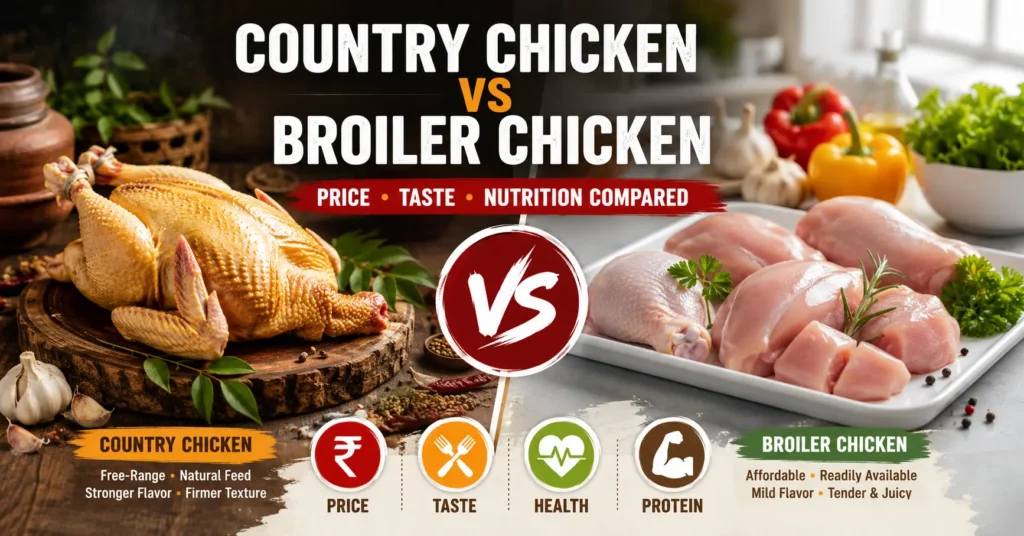
What Is the Real Difference Between Country Chicken and Broiler Chicken?
Before we get into rupees and recipes, it helps to understand what you’re actually comparing. Broiler chicken is a fast-growing hybrid breed, developed specifically for meat production. Farms raise these birds in controlled sheds with regulated temperature, formulated feed, and a strict growth timeline. A broiler reaches slaughter weight in around 40 to 45 days.
Country chicken, also called desi chicken or nati chicken depending on the region, is a completely different animal in every sense. These are indigenous, free-range breeds such as Aseel, Kadaknath, or Giriraja, raised the traditional way. They roam, forage for insects and grain, build muscle through natural movement, and take anywhere from three to six months to mature. That extra time and freedom is the root cause of almost every difference you’ll read about below, from price to protein to how the meat behaves in a pan.
If you want to see how this same “how it was raised” question applies to poultry freshness more broadly, our earlier piece on fresh chicken vs frozen chicken covers how processing and chilling methods change texture, which pairs well with what you’re about to read here.
Country Chicken vs Broiler Chicken: Price Comparison in Bangalore
Let’s talk numbers, because this is usually the deciding factor for most households. Prices move daily based on feed costs, demand, and season, but here is a realistic snapshot for Bangalore buyers right now.
| Chicken Type | Cut / Form | Approximate Price (Bangalore) |
|---|---|---|
| Broiler Chicken | Live (Wholesale) | ₹110 – ₹125 per kg |
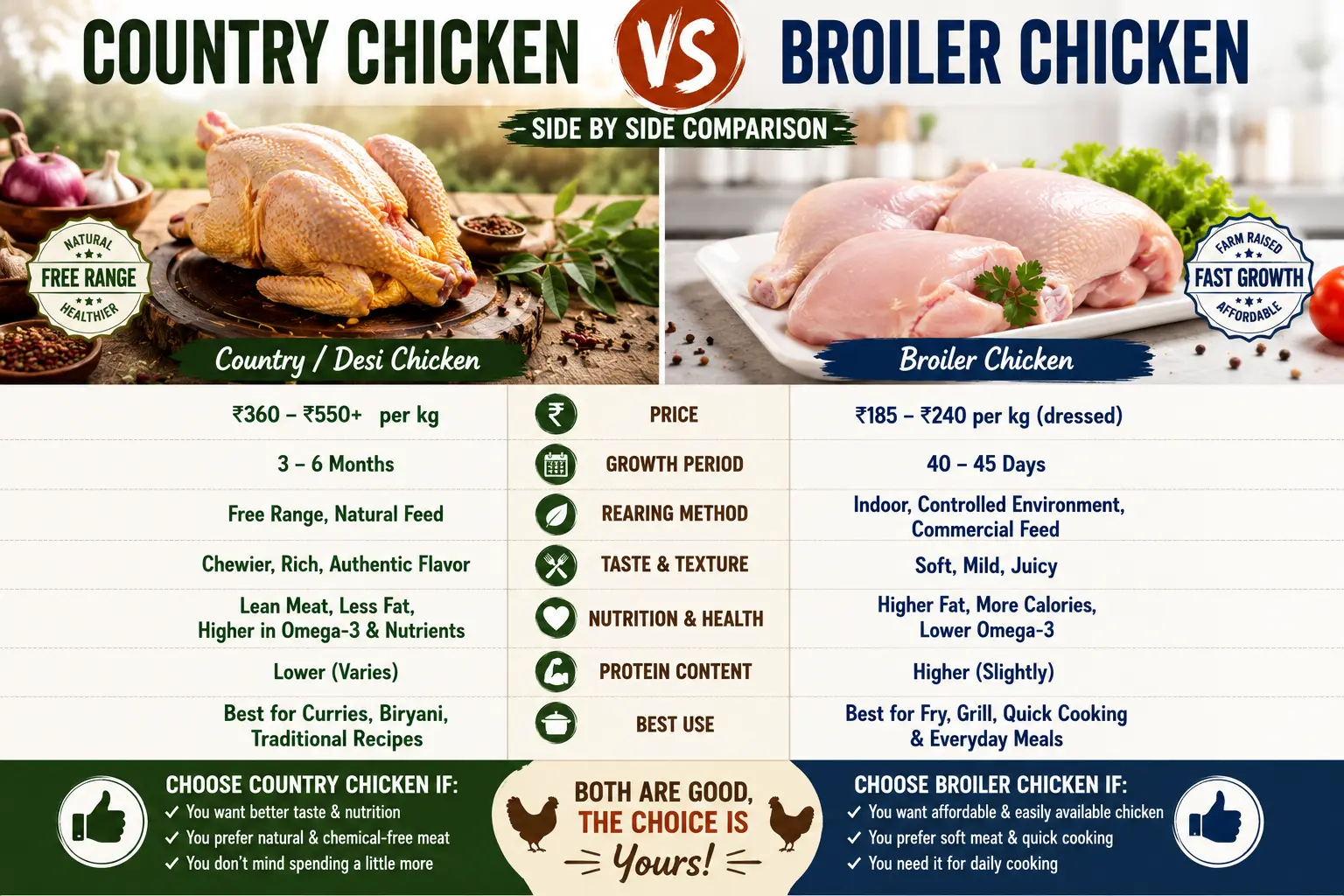
| Broiler Chicken | Dressed (With Skin) | ₹185 – ₹240 per kg |
| Broiler Chicken | Boneless | ₹280 – ₹360+ per kg |
| Country / Nati Chicken | Dressed | ₹360 – ₹550 per kg |
| Country / Nati Chicken | Premium Free-Range | ₹550 – ₹800+ per kg |
You’ll notice the country chicken price per kg can run two to three times higher than a dressed broiler. That gap is real, it is consistent across most Indian cities, and it is not a random markup. For a deeper, real-time breakdown of how these numbers shift week to week, our detailed guide on current chicken prices in Bangalore tracks wholesale and retail rates across multiple markets, and our piece on boneless chicken price per kg is worth a look if you’re specifically comparing cut prices.
Broiler Chicken Price Today: A Quick Snapshot
The broiler chicken price today tends to stay fairly predictable because supply is farmed at scale, which is exactly what keeps it affordable for daily cooking. Retail prices in central areas like Indiranagar or Koramangala usually run 10 to 20 percent above wholesale hubs like Russell Market or KR Market, mostly because of convenience and shop overheads rather than any difference in the bird itself.
It’s worth checking the broiler chicken price today before you shop rather than relying on last week’s number, since feed costs and weekend demand can shift rates by ₹20 to ₹40 per kg within a matter of days. Tuesdays and Wednesdays typically see the softest pricing across most Bangalore markets, simply because weekend demand has cleared out and fresh stock is arriving again.
Cost Per Meal: A Fairer Way to Compare
Looking only at price per kilogram can be misleading, because the two birds don’t yield the same amount of usable meat. A whole broiler carries proportionally more breast meat and less bone weight, while a country chicken, being leaner and more active in life, often yields a smaller usable portion relative to its live weight. When you work out cost per meal rather than cost per kilogram, the gap between the two narrows slightly, though country chicken still comes out meaningfully more expensive for the same number of servings.
How Season and Demand Move the Broiler Chicken Price Today
If you’ve ever wondered why your regular chicken shop charges different rates from one week to the next, seasonality is usually the answer. The broiler chicken price today in Bangalore can swing noticeably around major festivals, monsoon disruptions, and even public holidays when demand spikes but supply chains slow down.
- Festival weeks (Diwali, Christmas, New Year): Expect prices to climb 10 to 25 percent above baseline as households stock up simultaneously.
- Monsoon season: Heavy rains can disrupt transport from farms in Hoskote and Nelamangala, occasionally pushing the broiler chicken price today higher for a few days at a stretch.
- Summer months: Demand often dips slightly as fewer people cook heavy non-vegetarian meals in the heat, which can soften prices.
- Weekends: A near-universal pattern across Indian cities, where Saturday and Sunday demand nudges prices up by ₹15 to ₹30 per kg compared to a Tuesday or Wednesday.
Country chicken follows a gentler version of the same pattern, since indigenous breed supply is already limited and doesn’t fluctuate with weekday demand quite as sharply. If you’re trying to time a bulk purchase for either type, the middle of the week remains your best window in almost every part of Bangalore, and it’s often when you’ll spot the most favourable country chicken price per kg at wholesale hubs.
Why Does Country Chicken Cost So Much More?
It comes down to basic economics of time and yield. A broiler farmer can turn over a batch of birds roughly eight times a year. A country chicken farmer gets maybe two, sometimes fewer if the birds are raised the slow, free-range way that gives them their signature texture.
- Growth time: Three to six months versus 40 to 45 days means far higher feed and labour costs per bird.
- Lower yield: Country chickens are naturally leaner with less breast meat, so you get less usable meat per kilogram of live weight.
- Limited supply: Fewer farms specialize in indigenous breeds, and demand regularly outpaces what small-scale desi farmers can produce.
- Higher mortality risk: Free-range birds are more exposed to weather, predators, and disease than sheds full of broilers, and farmers price that risk in.
None of this is a scam. When you’re paying for country chicken, you’re paying for a slower, more labour-intensive farming model, not a fancier label on the same product.
Country Chicken Goes by Many Names, and That Can Confuse Pricing
One reason people get caught off guard by the country chicken price per kg is that the same bird gets sold under different names depending on the region and the shop. In Karnataka and Tamil Nadu, you’ll commonly hear “nati chicken” or “naatu kozhi.” In Andhra Pradesh and Telangana, it’s often just called “desi kodi.” Kerala shops may list it as “naadan kozhi.” These aren’t different products, they’re regional names for the same indigenous, free-range breed category, so don’t assume a shop charging a different rate under a different name is selling something entirely different from what your neighbourhood market calls country chicken.
Desi Chicken vs Broiler Chicken Taste: What Your Tongue Actually Notices
This is where the debate gets emotional, and honestly, for good reason. Desi chicken vs broiler chicken taste isn’t just perception, it’s measurable. A country chicken’s varied natural diet of grain, insects, and greens, combined with constant movement, builds denser muscle fibre and a different fat distribution than a broiler that has spent its life in a temperature-controlled shed eating formulated feed.
The result is meat that’s firmer, chewier, and carries a deeper, almost gamey flavour that holds up beautifully in slow-cooked curries. Broiler meat, by comparison, is softer, milder, and cooks faster, which makes it far more forgiving for quick weeknight meals. Neither is objectively “better” tasting; they’re built for different dishes entirely.
“You don’t cook country chicken and broiler chicken the same way and expect the same result. One is built for a slow simmer, the other for a quick sear. Respect the bird you bought.” Local Poultry Trade Expert
If you ask ten different home cooks to describe desi chicken vs broiler chicken taste in one word, you’ll likely hear “rich” or “earthy” for country chicken and “clean” or “mild” for broiler. Neither description is wrong, and both point to the same underlying cause: how the bird lived shapes how it eats.
Texture Breakdown
| Attribute | Country Chicken | Broiler Chicken |
|---|---|---|
| Texture | Firm, chewy, dense muscle fibre | Soft, tender, quick to cook through |
| Flavour | Deep, rich, slightly gamey | Mild, neutral, absorbs marinades fast |
| Fat Distribution | Lean overall, fat concentrated near skin | More evenly marbled, higher overall fat |
| Cooking Time | Longer; suited to slow curries and stews | Shorter; suited to grilling, frying, quick curries |
| Best Dish Style | Chettinad curry, traditional biryani, slow-cooked stew | Tandoori, stir-fry, quick weeknight curry |
Is Country Chicken Healthier Than Broiler Chicken? The Nutrition Facts
Here’s where a lot of blogs get sloppy, so let’s stick to what’s actually documented. According to nutrient composition data compiled by the ICMR-National Institute of Nutrition, indigenous and free-range poultry breeds generally show a leaner fat profile and a marginally higher protein density than intensively farmed broiler breeds, largely because of the difference in physical activity and natural feed. That said, both are legitimate, high-quality protein sources, and the practical difference in a home diet is smaller than marketing often suggests.
So, is country chicken healthier than broiler chicken? The honest answer: it can be, modestly, in terms of fat content and mineral density, but broiler chicken is not an unhealthy choice. It remains an excellent, affordable, high-protein option that fits easily into daily meal planning, especially for anyone tracking macros or building a consistent workout diet. If you’re specifically optimizing meals around protein intake, our guide on fresh chicken sourcing standards is a useful next read.
Nutritional Snapshot (Per 100g, Approximate)
| Nutrient | Country Chicken | Broiler Chicken |
|---|---|---|
| Protein | ~24-26g | ~22-24g |
| Fat | ~5-7g | ~8-12g |
| Calories | ~150-165 kcal | ~165-190 kcal |
These figures vary by cut, cooking method, and individual bird, so treat them as a general guide rather than a lab certificate. For any household following a medically prescribed diet, always check with a nutritionist rather than relying on blog averages.
Which One Should You Cook Tonight? A Dish-by-Dish Guide
Rather than picking a permanent winner, the smarter approach is matching the bird to the dish. Here’s a straightforward way to decide.
- Sunday family biryani or a festive gathering: Country chicken. The firmer texture holds up through the long dum cooking process without falling apart.
- Weeknight stir-fry, quick curry, or grilled dinner: Broiler chicken. It cooks faster and stays tender even with minimal prep time.
- Traditional Chettinad or Andhra-style curry: Country chicken. The bold spice blends in these recipes were built around desi chicken’s deeper flavour.
- Tandoori, kebabs, or 65-style fried chicken: Broiler chicken. Its milder base takes on marinades quickly and grills evenly.
- Meal-prep lunches for the week: Broiler chicken breast, for the lean, consistent protein at a manageable price point.
How to Buy the Right Chicken Every Time
Whichever you choose, freshness matters more than the breed. A few checks to run before you buy, whether you’re at a local market or ordering for delivery:
- Check the colour. Fresh meat should look pink to pale yellow. Grey or dull patches are a warning sign.
- Press the flesh. It should spring back. If your fingerprint stays pressed in, move on.
- Smell it. A neutral or very mild smell is normal. Anything sharp or sour means it’s past its best.
- Ask about the source. A shop that can tell you when the batch arrived is usually more reliable than one that can’t.
- Look for hygiene compliance. Always prefer sellers who follow FSSAI food safety guidelines for meat handling and storage.
If you’d rather skip the market trip altogether, browsing our fresh chicken category gets you same-day, antibiotic-free options delivered straight to your door in Bangalore, already cut to your preference.
A Simple Rule of Thumb When You’re Undecided
If you’re still weighing country chicken vs broiler chicken at the counter and can’t decide, ask yourself two questions. First, how much time do you actually have to cook tonight? If it’s under 30 minutes, broiler is the safer bet. Second, is this meal for a special occasion where flavour depth matters more than convenience? If so, the higher country chicken price per kg is usually worth it. Most home cooks in Bangalore end up keeping both in rotation rather than picking one permanently, using broiler for the weekday grind and country chicken for the weekend spread.
Frequently Asked Questions
Which is better, country chicken or broiler chicken?
Neither is universally better. Country chicken wins on flavour depth and holds up in slow-cooked dishes, while broiler chicken wins on price, cooking speed, and everyday convenience. The right pick depends entirely on what you’re cooking.
Why is country chicken so much more expensive than broiler?
Country chicken takes three to six months to mature compared to roughly 45 days for broiler, and yields less usable meat per bird. That longer farming cycle, combined with lower supply, is what drives the country chicken price per kg well above broiler rates. Expect to pay roughly two to three times the going broiler rate for a comparable dressed weight.
How much does country chicken price per kg typically vary between shops?
Even within the same city, the country chicken price per kg can differ by ₹50 to ₹100 depending on whether you’re buying from a wholesale market, a neighbourhood butcher, or a premium delivery app. Wholesale hubs almost always offer the lowest rate if you’re comfortable buying whole birds rather than pre-cut portions.
Can I substitute broiler chicken in a country chicken recipe?
You can, but reduce the cooking time significantly since broiler meat cooks much faster and can turn mushy if simmered as long as a traditional country chicken recipe demands.
Is broiler chicken safe to eat regularly?
Yes. Broiler chicken sourced from FSSAI-compliant sellers is a safe, high-protein food suitable for regular consumption as part of a balanced diet.
Does country chicken really taste different, or is it just perception?
It’s a real, documented difference rooted in diet and muscle activity, not just perception. The denser muscle fibre from a free-range lifestyle genuinely changes both texture and flavour compared to a shed-raised broiler.
Final Thoughts: Making the Right Call for Your Kitchen
The country chicken vs broiler chicken debate doesn’t really need a winner. What it needs is a buyer who understands what each bird brings to the table. Country chicken delivers a richer, more traditional flavour worth the premium for special meals, while broiler chicken remains the practical, protein-packed choice for everyday cooking. Once you know the real price gap, the genuine taste difference, and what the nutrition data actually says, you’re no longer guessing at the meat counter, you’re making an informed decision every single time.
Whichever you choose for tonight’s dinner, sourcing it fresh matters more than the breed on the label. Explore Diamond Fresh Chicken for same-day, antibiotic-free delivery across Bangalore, or read more kitchen guides like our comparison on finding fresh chicken near you and our breakdown of buying chicken online in Bangalore to round out your next grocery run.